
President:
Bev Laidlaw (Sheffield)
Vice Presidents:
Dave Semple, (Wigan)
Rachel Heemskerk (Essex)
Abigail Clarke (Sheffield)
Vijay Menezes-Jackson (Edinburgh, Lothian & Borders)
Assistant Secretaries:
Ian Brown (Sheffield)
Paul Suter (HQ Sheffield)
Saorsa-Amatheia Tweedale (Bradford)
Katrine Williams (Ty Taf)
Declan Power (West London)
George Thompson (North & Outer East London)
Chris Marks (HQ London)
Editor:
Sam Johnson (Lanarkshire)
Treasurer:
Emma Scott (Essex)
Organiser:
Craig Worswick (Greater Manchester)
Group Executive Committee:
1.Paul Darvell (Hull & East Riding)
2. Chris Evison (Barnsley & Rotherham)
3. Jill Fearn (Sheffield)
4. Yemisi Ilesanmi ( London HQ )
5. Reece Lawton (East Hampshire & Isle of Wight)
6. Alan Loy (Stockport & Tame Valley)
7. Dave Rees (Black Country)
8. Sarah Thomas ( Calderdale, Kirklees & Wakefield)
9 Catherine Toomer (North Yorkshire)
10. Tom Bishell (Sheffield)
11. Abigail Clarke (Sheffield)
12. Bev Laidlaw (Sheffield)
13. Chris Marks (HQ London)
14. Jenny Pollard (Cumria & Lancashire)
15. Declan Power (West London)
16. Vijay Menezes–Jackson (Edinburgh, Lothian & Borders)
17. George Thompson (North & Outer East London)
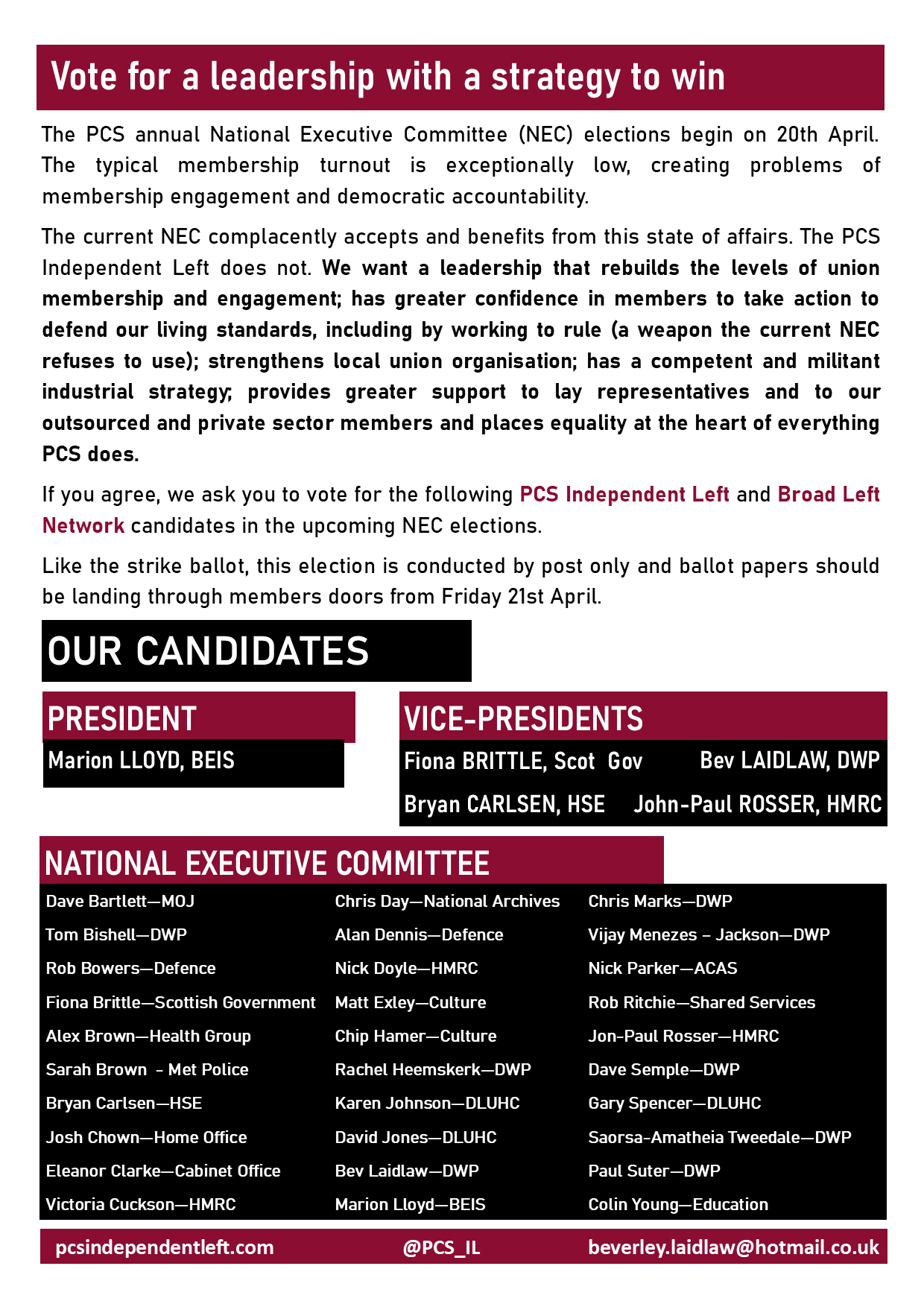
Members are in the middle of the largest dispute we’ve seen for over a decade. But in order to win we need a joined-up strategy of escalation of national action alongside creative, sustained and most importantly, disruptive targeted action. As the stakes are so high The Independent Left and The Broad Left Network are standing a joint list of candidates to fight for this in the year ahead. Please nominate these candidates at your branch’s Annual General Meeting.
These Candidates will…
Candidates
President
Marion Lloyd, BEIS
Vice Presidents
Fiona Brittle, Scottish Government
Bryan Carlsen, HSE
Bev Laidlaw, DWP
Jon-Paul Rosser, HMRC
NEC members
By supporters of PCS Independent Left on the National Young Members Committee
Supporters of Independent Left have been putting forward in our branches and other committees that the best way to support the planned campaign of targeted action is through a substantial programme of all-out action.
It is the targeted action that will win the pay rise we need, but placing our struggle into isolated pockets while the rest of the union is ordered by our leadership to simply watch on will not win our colleagues over to take part in the targeted action and throws away the momentum of the campaign that workplace activists have been building over the last year.
It is exactly this threat to our campaign that supporters of Independent Left wanted to discuss at the National Young Members Committee meeting on 29 November.
The original draft of the motion was ruled out of order on the ground that as an advisory committee, we could only “advise” and not “call on” the NEC to take any position. However, this quick rewording was evidently not enough – apparently advisory committees do not have the power to advise the NEC of our views despite the clear wording of our constitution.
After some further wrangling, It was finally agreed that we would hear the motion as a “discussion paper.”
Much to our surprise, however, Fran Heathcote, President of the union had somehow invited herself to the meeting of young members to shout us down.
Despite having a printed copy of the motion in her hand, Fran had evidently not taken the time to read it. Inserting herself into the young members debate, she accused Independent Left of not supporting the targeted action in favour of only “protest action.”
An indicative vote was held which unfortunately saw the IL position fall to 5 against, 2 for, 3 abstentions. Despite this, however, Fran was described even by supporters of her position as “rude” and “patronising,” forcing many away from her method of organising.
Fran launching herself into attack against young members discussing the leadership’s risky strategy mirrors efforts by the leadership faction to smash any effort to suggest alternatives and for a broader layer of Civil Servants to join the struggle for better pay.
While Independent Left are critical of the leadership’s strategy and are calling for it to be reversed, we will do everything we can to ensure the campaign strategy, whatever it is, will be a success. We note, however, that the leadership’s position of isolating sections of the union to go it alone is only serving to isolate the themselves from the growing call of members in every department to join the targeted action out on strike.
Motion below:
The National Young Members’ Committee notes that:
The National Young Members’ Committee further notes that on 18 November:
The National Young Members’ Committee agrees that:
We have produced the following model motion for branches to pass; if they feel that it was a mistake not to call national action this year alongside the targeted action called by the union last week.
In our response last week we made the point that this strategy has the danger of demobilising members engaged throughout the ballot period, and risks those being asked to take targeted action feeling they are acting alone. We need national days of action as a springboard for the selective action planned.
BECs can submit motions directly to the NEC and they will be tabled for visibility. If these motions come from a properly conducted members’ meeting then the NEC is obliged to discuss them too. Regardless which body passes them, it’s important that branches show the strength of feeling on the current strategy to the leadership.
Please let us know if you pass the motion in your branch or need any support in doing so:
Branch motion on national action for the PCS NEC
This Branch/Branch Executive Committee notes that:
This Branch/Branch Executive Committee further notes that on 18 November:
This Branch/Branch Executive Committee agrees that:
The PCS National Executive has rejected calls for national action alongside announced targeted action.
Just over a week ago the union saw the biggest participation and largest vote in favour of action in the union’s history.
This was the result of 6-weeks of huge member and activist engagement right across the union. During this period the union grew significantly, new, young activists were inspired to join-in fighting as part of the campaign. Members voting for action for the first time due to the severity of the impact of the cost-of-living crisis and effective workplace agitation around the issues.
The strategy this time was different. The tactics long argued by Independent Left for targeted or selective action meant to cause as much disruption as possible is now universally agreed as the way the dispute will be won.
But targeted action must be complemented by national action.
National one day strikes on their own is rightfully seen as a weak strategy, little better than a protest action. In the past, members have seen the poverty of a strategy which sees them lose a day’s pay for minimal disruption.
But national action when used alongside targeted action is not protest action. Its purpose is to buoy those taking targeted action and to demonstrate in a real way that they are not acting alone, it’s to give all members a stake in the campaign. Most importantly it’s to retain the momentum among members in all workplaces and as a recruiting sergeant.
Equally, there are live disputes over office closures and redundancies in the DWP and Department for Education both now with mandates for action, but no action has yet been called.
The Independent Left argued at today’s NEC that members being asked to take sustained selective action should be supported by at least a day of national action by all members with mandates to strike as a springboard to the campaign.
IL argued that with the posties in the CWU calling 6 days of action in December, and lecturers in the UCU with 3 days starting at the end of this month, there could also be effective coordination with other unions.
The NEC majority opposed this and it was defeated with targeted action in a few areas being given the green-light this side of Christmas and no view of when – if at all – any national action will be called.
This represents a serious strategic mistake, risks widescale demobilisation and demoralisation of those being asked to take action as well as those who have effectively been stood-down from the campaign and many activists and members are rightfully disappointed.
Clearly, the action called today needs to be unconditionally supported with reps mobilising support for the pickets. But members and reps in branches, groups and on regional committees should discuss the NEC decision and if they agree with us, propose and pass motions outlining their concerns to send to the NEC and General Secretary. The more that do so, the bigger impact it will have. Please get in touch if you are planning to do so, or would like support.
It is also clear that control of the dispute is not in the hands of the rank-and-file. We have long argued that disputes, including demands and strategy should rest, democratically with the membership. There already appears to be a significant number of members and reps who disagree with today’s decision and we think there should be a forum for those individuals to discuss a way forward.
National Branches and Groups still retain the option of submitting requests for action to the National Disputes Committee and those passing the threshold already have a mandate. These committees may consider their membership and decide they want to take national action in support of the targeted action. They should discuss this with their membership and send requests to the NDC. Our expectation would be that the NDC should accept these requests as refusing them would represent a top-down block on members action. But branches and groups should not have to be in this position as a consequence of the misjudged strategy of the NEC!
We will be posting more in the coming days about organising discussions with branches and reps.
The NEC should reverse its decision to stand-down tens of thousands of members, but minimally need to articulate to members whether there will be any national action in the New Year.

 PCS Independent Left