
Missed PCS ADC? Why not have a read of our bulletins and catch up. We are the only group in the union to produce daily conference bulletins, responding to the debates and providing a perspective on upcoming motions. We also hold conference fringe meetings and a conference social.


Trans exclusion: A stain on PCS
With PCS’s annual delegate conference concluding on Thursday, we wanted to share a report of the main issue of the conference.
As we have reported on earlier: The General Secretary, President and the National Standing Orders Committee made a number of decisions and statements in the run-up to and during this week’s conference which attacked the rights of trans delegates and blocked the discussion of motions of trans solidarity in the wake of the Supreme Court Judgement on the Equality Act.
The primary issues were:
- The President and General Secretary, without NEC consultation, releasing a public statement in advance of conference which stated that the union was intent on enforcing their own interpretation of the Supreme Court Ruling, advising trans delegates not to use the toilet of their gender. In doing so enforcing segregation and causing harm and harassment to our trans delegates and placing PCS to the right of the rest of the trade union movement, the Brighton Conference Centre and Civil Service Employers.
- The Standing Orders Committee sending all motions from branches which mentioned ‘the trans issue’ in bulk to the unions lawyers, asking for legal advice ‘in the wake of the Supreme Court ruling’. And subsequently ruling that not only would none of the motions be put to conference, but that none of them would be printed and that this decision could not be challenged. This included a motion from MHCLG HQ Branch which was unceremoniously thrown into the ‘bulk submission’, but to which the legal advice didn’t relate.
- The Standing Orders Committee, on the eve of conference, ruling that motion A57 on trans rights which had already been printed and circulated as part of the original motions booklet, would also be ruled out of order. The legal advice for this wasn’t forthcoming and had to be fought for on conference floor by the majority of delegates continuously refusing to adopt standing orders.
When the advice was provided, it did not relate to this year’s Supreme Court ruling at all, rather it stated that calling on the union to ‘oppose exclusionary ideologies that reduce human experience to the biological characteristics of sex alone’ was likely to infringe the rights of those who hold such ideologies as a protected characteristic under the equality act. Leaving us to ask whether existing PCS policy confirming that trans women and women and trans men are men still stands or is itself ‘illegal’.
Who controls conference?
As a result of the above, conference, taking the lead from trans delegates and allies, refused to endorse standing orders, with passionate speeches and heckles from the floor demanding that minimally motion A57 was reinstated onto the agenda.
Regardless of the SOC legal advice, the President could have accepted A57 as it had already been printed, and the supposed legal jeopardy already breached, by simply calling for a vote on a previous Standing Order Report which included it, but he did not.
In a twist of bitter irony, conference was told repeatedly from the Chair, that it was the sovereign body of the union, despite repeatedly refusing to allow votes to overturn the Standing Orders ruling out of all the trans solidarity motions, on the basis that the Chair of Standing Orders had the constitutional authority to simply refuse for them to be heard.
To imbue one individual, regardless of political stripe, with the authority to rule-out any motion on the grounds of legal jeopardy and the legal responsibility to do so, is not a tenable or democratic situation and completely undermines the idea that PCS is a member led union.
PCS Independent Left will be proposing rule changes for next year’s conference to ensure that minimally, it’s conference who endorses any such ruling after being furnished with the legal advice, and that the union indemnifies any individual against legal challenges arising from it, as it does already with the NEC.
We also welcome the election of members of the Coalition for Change to the Standing Orders Committee to challenge such behaviour next year.
Annual Conference should be the sovereign body of the union. Not the Standing Orders Committee and certainly not the lawyers.
When the law is wrong, we fight the law
There is broad consensus that the Supreme Court ruling is detrimental to trans rights. We consider the ruling and the subsequent interim EHRC guidance as part of a cultural and legislative trajectory of erasure of trans people from society.
When unions in the deep south were faced with legally enforced racial segregation through Jim Crow, did they simply accept the law or did they break it in order to organise black and white workers against it? Did unions simply accept the poll-tax when it became law, or did they support the mass campaign of non-payment to oppose and ultimately defeat it?
Did our own union simply accept the law had changed disallowing union membership at GCHQ, or did they oppose it and support each and every rep who was sacked as a consequence?
There are, of course, many other examples of unions refusing to accept the law when it challenges the rights, or in this case, the existence of their members.
PCS activists and members need to ask themselves and their leadership – why is it different this time?
The President, General Secretary and the Standing Orders Committee chose to seek legal advice on this question. It is beyond comprehension that they did not know what the response would have been.
But even if they hadn’t, there are other motions on the order paper which could have been challenged legally on a similar basis to the trans solidarity motions. Unison, for example, regularly rules out motions on industrial action on the same basis, using legal advice from the same lawyers as PCS. Why weren’t these motions sent to the lawyers?
At best it’s cowardly and conservative. At worse, underhanded, exclusionary and undemocratic.
It is also important to note that some Group conferences taken this week, did allow similar motions to be debated and voted on, which almost entirely debases the rationale behind excluding them from national conference.
An existential fight
This is not an issue like the debate on the national campaign, or our strategy on hybrid working. This is an existential fight for the trans community. This is why there was rightfully a majority to refuse accepting standing orders on two successive votes.
We sincerely hope that delegates who were frustrated about the delayed start to conference recognise this and direct their frustration to those who prevented the interests of our trans members being debated by conference.
In behaving as they have, PCS Left Unity have not only thrown our trans members under the bus, but have – potentially unwittingly – signalled to transphobes in the wider trade union movement how to ensure similar situations are played out in other unions.
We want to be very clear to every rep and member, that is the consequence of their behaviour this week.
If there was one incident which demonstrates this the most, it was the emboldening of transphobes to an extent that for the first time at PCS conference, they felt it acceptable to boast from the podium of misgendering and presuming the gender of delegates and harassing them in the toilets. Later providing the same perspectives freely to the Daily Mail.
The power of self-organisation
We want to pay a huge tribute to the self-organisation of trans delegates who led allies in refusing to back down, despite the force of the leadership, lawyers, the standing orders committee and full-timers acting against them.
We also don’t want activists to be disheartened. The power shown on the conference floor during the debate on standing orders and during the Equalities section and the continuous stream of delegates throughout the conference highlighting support for trans siblings should be heartening. There is an organisation here which isn’t going away.
PCS Independent Left will continue to back our trans members and the wider trans community.
Solidarity means listening to the voices of oppressed people, not silencing them. It means amplifying their demands, not refusing to print them. It means backing them, regardless of the law.

Championing equality at the heart of PCS
At this year’s ADC, the PCS Independent Left reaffirm our unwavering commitment to placing equality at the core of everything we do. In a time of growing division and hostility, we must stand united in our fight for justice, dignity, and inclusion for all members.
Standing with Transgender and Non-Binary Members
We are deeply concerned by the Supreme Court judgment narrowing the legal definition of “woman.” This ruling undermines the rights and recognition of our trans and non-binary members. The IL believes our union must:
· Campaign vigorously against this judgment, defending the rights of all members to self-identify
· Support motions and emergency motions at ADC that empower our leadership to advocate for trans rights both within PCS and across society
· Ensure our union is a safe, inclusive space where all gender identities are respected and celebrated
Confronting the Far Right and Racism
The rise of the far right poses a direct threat to PCS members and the communities we serve. Their agenda of racism, scapegoating, and violence must be met with firm resistance. We call on PCS to:
· Work in solidarity with other unions to oppose racism
· Advance anti-racist policies that challenge scapegoating and protect our communities
· Educate and mobilise members to recognise and resist far-right narratives in the workplace and beyond
Embedding Equality in Every Campaign
PCS must lead by example, embedding equality into every campaign and workplace initiative. Our national equality programme must:
· Spread best practices and ensure all personnel policies are equality-checked and legally compliant
· Address systemic inequalities, including the overrepresentation of ethnic minority, disabled, and lower-grade members in personal cases
· End the multi-tier workforce, which leaves newer, often younger staff on inferior terms
· Champion flexible working, giving all members the right to choose where they work based on their wellbeing and personal commitments
Statement by PCS Proud NC on ADC 2025
The PCS Proud National Committee is appalled to find that 25 motions at ADC 2025 have been marked out of order – an unprecedented number compared to just 3 last year – due to legal concerns. It has not escaped our attention that the majority of these out-of-order motions relate to trans rights.
For example, one emergency motion proposed by three branches was ruled out of order for including the phrase: “Publicly commit to all trans people being able to use the facilities of their choice at all PCS events/buildings, including ensuring that trans women are welcome in all women’s spaces in our union.” The legal consultation received by the Standing Orders Committee advised that this phrase could expose the union to legal risk. It was argued that the statement conflicted with the Equality Act 2010, which permits the separation of sexes in certain contexts. However, this advice ignored a wealth of legislation and case law that recognises trans people in accordance with their gender identity—and that gender identity and phenotypic sex are not the same. Proud’s own emergency motion on the recent Supreme Court ruling was among those dismissed.
The PCS Proud National Committee condemns the National President’s use of legal advice obtained from Thompsons to rule out motions they do not agree with, under the pretext of legal risk. We are deeply concerned about the constitutional implications of this approach, which suggests that Conference is no longer the sovereign body empowered to determine union policy—even where that policy might challenge the current legal framework. The National President’s use of legal mechanisms, alongside his presidential rulings throughout the year to prevent the National Executive Committee (NEC) from taking actions he opposes, is further evidence that our National President, Martin Cavanagh, is intent on ruling by presidential decree.
This deference to a “ruling of the highest court in the land”—a ruling made without any trans voices, yet informed by trans-exclusionary groups like Sex Matters and For Women Scotland, and referencing a non-statutory, arguably unlawful EHRC proposal—is deeply troubling. Despite claims to the contrary, the law itself has not changed. The Civil Service is under instruction not to amend existing guidance until legal advice is obtained on the complex interaction between various pieces of legislation.
However, delegates arriving at Conference received a statement requesting that trans people use either the facilities associated with their birth sex or a ‘third space’. This statement was issued on 17 May—the International Day Against Homophobia, Biphobia, and Transphobia. The Brighton Centre’s own policy had not been updated, and amid the potential outcry, the proposal was quietly dropped. Most group presidents refused to read the bathroom statement when opening their respective conferences.
NEC member and PCS Proud NEC liaison officer Fiona Brittle submitted a motion to condemn and withdraw both the legal advice and the bathroom guidance at the 9.30 p.m. NEC meeting on 18 May. This motion will be published separately. It was shared with the Chair and all NEC members in anticipation that President Martin Cavanagh would rule it out of order and refuse a debate or vote.
Fiona attempted to raise a point of order on the blocked motion, at which point Martin prevented her from speaking and ruled that the motion would not be heard, allowing the statements to stand. She challenged the Chair’s ruling, which was put to a vote. Her challenge passed with a majority of 18–14, but the ruling was upheld, as NEC standing orders require a two-thirds majority to overturn the Chair.
In addition to rejecting 25 emergency motions in support of trans rights, the National Standing Orders Committee (NSOC) also refused to print Motion A57 in the agenda. Motion A57 predates the Supreme Court ruling and had initially been included in the SOC1 paper for debate at ADC. It was printed and ready for debate up until May 20, the day the Annual Delegate Conference began. Legal advice had been provided on the same day, dated May 20 leaving no room to challenge its removal from the agenda. With the removal of A57 from the agenda, only two motions relating to trans rights remained: one on communications and the other on the Sullivan Review.
Both of the remaining motions were written after the Supreme Court ruling. One addressed the publication of the Sullivan Review, while the other concerned the union’s communications on LGBT+ and equalities matters. Both motions were drafted with the assumption that A57 would already appear in the SOC1 motions booklet for debate. Its removal was unthinkable. These two motions, along with Proud’s emergency motion and 24 other emergency motions on the Supreme Court ruling, were intended to complement A57—not replace it. Neither of these motions were intended to serve as the flagship trans rights motion at ADC 2025. Neither motion called for the union to denounce bio-essentialism. Both were narrow in scope, with the Sullivan motion focusing solely on data collection. Without A57 and the emergency motions, there were no strong motions on trans rights for Conference to debate.
Contrary to implications in the legal advice, transphobia is not a “protected philosophical belief” under the law. That suggestion stems from a deliberate misreading of case law. The Equality Act 2010 clearly provides that one protected characteristic cannot be used to justify discrimination against another. For example, a religious belief cannot be used to discriminate against someone for their sexual orientation. The advice from Thompsons reflects a “zero risk” approach—but what trade union activity carries zero risk? Our role as trade unionists is to advocate for our members, and that often means challenging the status quo—especially when the law is wrong.
Unions played a crucial role in overturning Section 28. Until 1991, domestic abuse was not considered a criminal matter if the parties involved were married. We did not accept that then, and we do not accept this now. The rule of law is not infallible—and when it is wrong, it must be resisted by any means necessary.
The Proud National Committee believes Thompsons was approached with the intent of providing legal cover to suppress motions and prevent them from being heard, knowing that these motions would likely pass and become union policy. The Committee will seek access to the original request submitted to Thompsons, as legal questions can be framed to shape the advice received. We do not believe the legal team arrived at this decision independently.
The suggestion that the union cannot affirm that a trans woman is a woman, and a trans man is a man, effectively silences union members. The PCS Proud National Committee also notes that similar events have occurred in Unison, where Thompsons has again been used to provide legal justification for quashing motions supporting trans rights.
In response, trade unionists fighting for trans rights began resisting acceptance of the Conference’s Standing Orders until A57 was reinstated. Multiple attempts were made, and Conference was nearly shut down as a result.
This resistance began when Saorsa Amatheia Tweedale, Chair of the PCS Proud National Committee, attempted to raise a point of order before the Standing Orders were accepted. The National President claimed that Conference had not yet begun, and therefore a point of order could not be raised. Saorsa then attempted to challenge the Chair’s ruling, but this was denied by the National President. The suggestion of course that points of order that the union’s rules are being broken cannot happen is nonsensical.
PCS Proud applauds the efforts of trans activists during the opening of Conference for their calls to reinstate A57 and in defence of principles of union democracy. Conference was nearly brought to a standstill as delegates refused to accept the Standing Orders until A57 was reinstated.
The floor voted multiple times on the issue, culminating in a card vote on whether to accept the Standing Orders:
- 49,016 voted against
- 72,087 voted to accept
- 4,105 abstained
Saorsa again attempted to raise a point of order about the guidance provided to Group Presidents who were instructed to read out a statement about the toilet facilities. Saorsa also highlighted a Facebook post that described the disruption as “men intimidating women”. Martin explicitly stated that he would not take action and did not consider it a transphobic slur. Shortly thereafter, Conference staff cut Saorsa’s microphone in an attempt to silence her.
Drawing attention to a social divide is not the same as creating one. Activists are often viewed as divisive by those who have grown comfortable with the privileges such divides afford them.
PCS Proud will continue to resist any effort to distort, erode, or erase the rights of Trans+, intersex, non-binary, gender non-conforming, and gender diverse people.
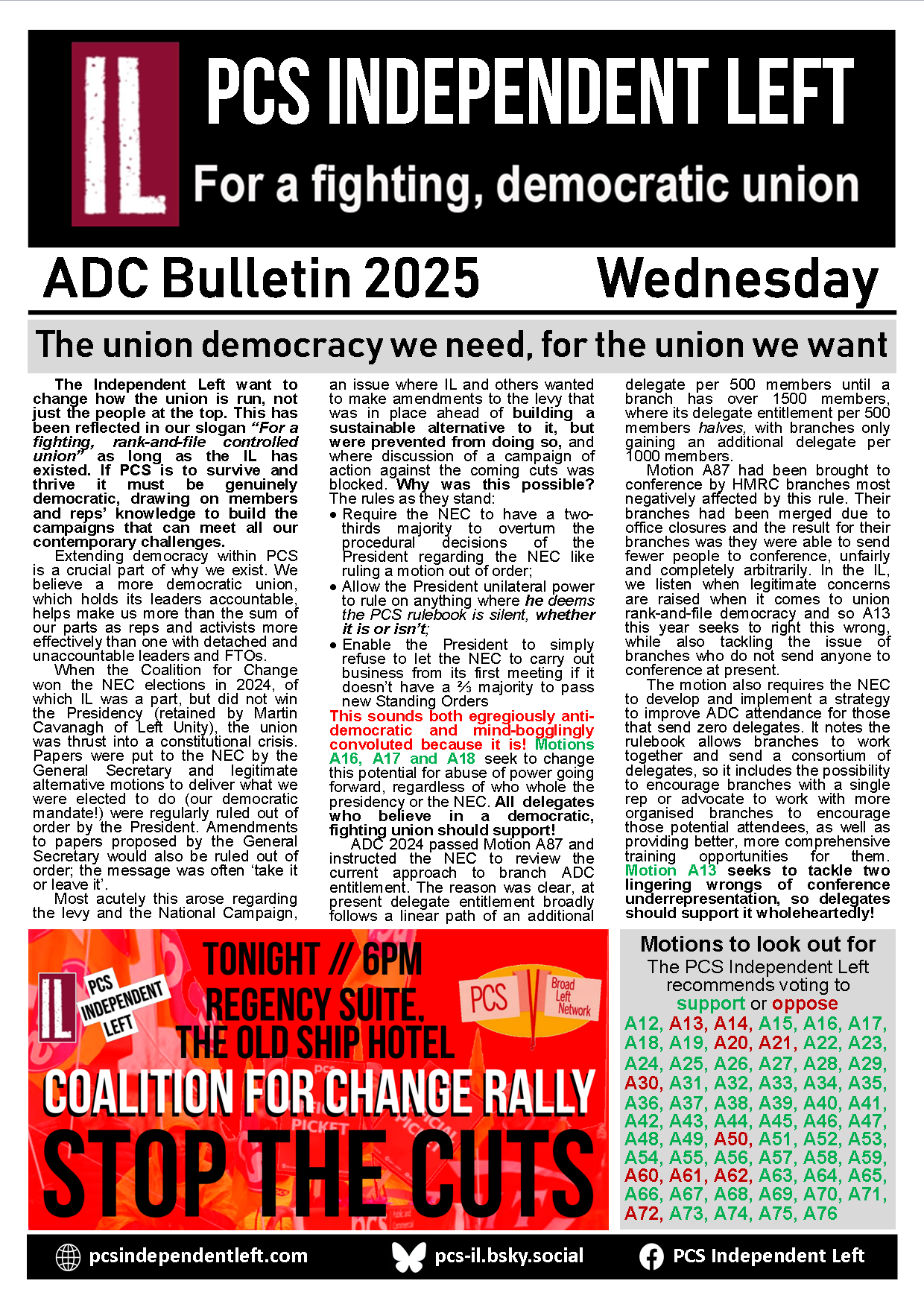
The union democracy we need, for the union we want
The Independent Left want to change how the union is run, not just the people at the top. This has been reflected in our slogan “For a fighting, rank-and-file controlled union” as long as the IL has existed. If PCS is to survive and thrive it must be genuinely democratic, drawing on members and reps’ knowledge to build the campaigns that can meet all our contemporary challenges.
Extending democracy within PCS is a crucial part of why we exist. We believe a more democratic union, which holds its leaders accountable, helps make us more than the sum of our parts as reps and activists more effectively than one with detached and unaccountable leaders and FTOs.
When the Coalition for Change won the NEC elections in 2024, of which IL was a part, but did not win the Presidency (retained by Martin Cavanagh of Left Unity), the union was thrust into a constitutional crisis. Papers were put to the NEC by the General Secretary and legitimate alternative motions to deliver what we were elected to do (our democratic mandate!) were regularly ruled out of order by the President. Amendments to papers proposed by the General Secretary would also be ruled out of order; the message was often ‘take it or leave it’.
Most acutely this arose regarding the levy and the National Campaign, an issue where IL and others wanted to make amendments to the levy that was in place ahead of building a sustainable alternative to it, but were prevented from doing so, and where discussion of a campaign of action against the coming cuts was blocked. Why was this possible? The rules as they stand:
· Require the NEC to have a two-thirds majority to overturn the procedural decisions of the President regarding the NEC like ruling a motion out of order;
· Allow the President unilateral power to rule on anything where he deems the PCS rulebook is silent, whether it is or isn’t;
· Enable the President to simply refuse to let the NEC to carry out business from its first meeting if it doesn’t have a ⅔ majority to pass new Standing Orders
This sounds both egregiously anti-democratic and mind-bogglingly convoluted because it is! Motions A16, A17 and A18 seek to change this potential for abuse of power going forward, regardless of who whole the presidency or the NEC. All delegates who believe in a democratic, fighting union should support!
ADC 2024 passed Motion A87 and instructed the NEC to review the current approach to branch ADC entitlement. The reason was clear, at present delegate entitlement broadly follows a linear path of an additional delegate per 500 members until a branch has over 1500 members, where its delegate entitlement per 500 members halves, with branches only gaining an additional delegate per 1000 members.
Motion A87 had been brought to conference by HMRC branches most negatively affected by this rule. Their branches had been merged due to office closures and the result for their branches was they were able to send fewer people to conference, unfairly and completely arbitrarily. In the IL, we listen when legitimate concerns are raised when it comes to union rank-and-file democracy and so A13 this year seeks to right this wrong, while also tackling the issue of branches who do not send anyone to conference at present.
The motion also requires the NEC to develop and implement a strategy to improve ADC attendance for those that send zero delegates. It notes the rulebook allows branches to work together and send a consortium of delegates, so it includes the possibility to encourage branches with a single rep or advocate to work with more organised branches to encourage those potential attendees, as well as providing better, more comprehensive training opportunities for them. Motion A13 seeks to tackle two lingering wrongs of conference underrepresentation, so delegates should support it wholeheartedly!
IGNORANT AND COWARDLY: Left Unity on ADC toilets and Trans Rights
Delegates to PCS conference have received an email from the General Secretary and President, Fran Heathcote and Martin Cavanagh, instructing them to strictly interpret the Supreme Court judgement on single-sex provision of services.
In it, it states: “We are well aware of the strength of feeling generated by the recent Supreme Court’s judgment and of our duty to act in accordance with the Equality Act 2010. To confirm, the Supreme Court of Justice which is the highest court in the land, held that the statutory reference to protection because of sex means biological sex i.e. those born male or female. The Equality Act 2010 also provides protection from discrimination for trans people under the protected characteristic of gender reassignment. […]
The Building Regulations 2010 (in England) require single sex toilets to be provided. The Brighton Centre provides those. The Brighton Centre also provides ‘toilets for everyone’. We are therefore confident that the centre provides the appropriate range of facilities. It is important to remember that, irrespective of our personal views, any breach of the Equality Act 2010 may give rise to legal liability and, on that basis, we ask all delegates to use the facilities in accordance with the above”.
The statement’s intent is sickeningly clear, while seeking to obfuscate behind legalese; it is an instruction to trans members of our union not to use the toilets they are used to using, and to use the ‘toilets for everyone’ instead. This position is legally ignorant as well as politically cowardly and we in the Independent Left support our members continuing to use the toilets they are used to using without overzealous and bigoted interpretation of the judgement and other legislation by the PCS leadership.
Ignorant: The Building Regulations do not regulate the ongoing use of existing buildings and the Equality Act is not mandating segregation of trans members!
For a leadership intent on dressing up their approach to handling the issue of trans rights in legalese, they are either misunderstanding what the Building Regulations actually mean or they are weaponising the ignorance of others to restrict the rights of trans members. To be clear, the Building Regulations in England apply when most ‘building work is being carried out or material changes of use (e.g. changing offices into flats) are taking place. Material alterations to an existing building can be building work, but they are only material where they would make a building not comply with the Regulations where it did so before, or where it would comply less than it already did (Part 2 of BR 2010 as amended)’.
So what does this mean here? It means the requirements on the owners of Brighton Centre (a building built in 1977 and last renovated in 2012) was to meet the regulations at the time those renovations took place. Part T of the Building Regulations, requiring same-sex facilities, was only inserted in October 2024, and is therefore in no way relevant for the provision of toilets for ADC 2025 today. In fact, the Government’s own statutory guidance on Part T, Approved Document T, makes this point abundantly clear: “The new requirement and associated guidance will not apply in relation to building work on a particular building where a building notice, an initial notice or an application for building control approval with full plans, has been given to the relevant authority in respect of that building before the day the new regulations come into force, 1 October 2024, and either the building work to which it relates: a. has started and is sufficiently progressed before that day; or b. is started and is sufficiently progressed within the period of six months beginning on that day. […]
Management of premises 0.6 The Building Regulations do not impose any requirements on the management of a building, but they do assume that a building will be properly managed. This includes, for example, assuring the maintenance of building services, keeping handles and locks in good working order, cleaning of sanitary ware, surfaces and floors, plus emptying disposal bins and restocking soap dispensers and toilet paper”.
The Building Regulations 2010 are therefore in no way an appropriate fig leaf for the General Secretary and President to hide behind when aiming to force trans members to use separate ‘third space’ toilets. It is plain ignorance of the law.
Even when one looks at the Equality Act 2010 itself, the current interpretation being put forward by the bureaucratic LU leadership clique of PCS is one that is very purposefully restrictive in nature when it does not need to be so. Section 29 and paragraphs 26-28 of Schedule 3 of the Equality Act 2010 read together with the restrictive interpretation of the Supreme Court judgment are a step backwards for trans rights. But while the judgement does create circumstances in which a service provider may legally provide different services based on sex and exclude trans people of that gender from that service, it does not mandate this and we should seek to be pushing back, not leaning in.
“A trans woman with a GRC who presents fully as a woman may feel she is more likely to prompt objections from other users if she enters the men’s changing room or other facilities than if she uses the women’s changing room or facilities. But in facing that dilemma she is in the same position as a trans woman without a GRC. Although such trans women may in practice choose to use female-only facilities in a way which does not in fact compromise the privacy and dignity of the other women users, the Scottish Ministers do not suggest that a trans woman without a GRC is legally entitled to do so”.
A reasonable plain reading of the judgement taken as whole is that it represents a sordid and significant step backwards in the legal rights of trans comrades but it does not mandate their segregation on a day to day basis in the way the PCS leadership is suggesting should happen. The judgment unfortunately creates a hostile environment for unscrupulous attacks against our trans members but, as we quote above, even the judgement itself recognises that many trans women (without GRCs) “may in practice choose to use female-only facilities in a way which does not in fact compromise the privacy and dignity of the other women users” in their day to day lives and while they highlight the Scottish Government does not argue they would be “legally entitled” to said space (read: able to bring a legal claim if excluded from such a space by an unscrupulous service provider) it demonstrably should not be the trade union itself acting as the unscrupulous service provider. This is exactly what we need to stand alongside our trans comrades to prevent, inside and outside PCS.
The leadership state that the Supreme Court is the ‘highest court in the land’ but given the interaction between the restrictive view of the judgement and Article 8 of the European Convention of Human Rights on the right to privacy and a family life without undue interference from the state, it is clearly not the ‘final’ court that will have a say on these matters. We should seek to defend trans members and their human rights in the first instance and the approach taken by PCS, seemingly following the EHRC interim guidance which it ostensibly criticised, is a choice to be opposed in the interests of our members.
Cowardly: PCS should be the progressive force encouraging change, not being the most reactionary force in how it acts!
The law has always been, and will always be, a moving target when it comes to trade union solidarity. When Section 28 of the Local Government Act 1988 “prohibited local authorities from ‘intentional promotion of homosexuality or publication of material with the intention of promoting homosexuality”, as well as “promotion of teaching in any maintained school of the acceptability of homosexuality as a pretended family relationship” many in the trade union movement were rightly part of the long campaign for its repeal. While thankfully, no prosecutions of teachers ever came forward, progressive union activists did everything they could to force a reversal of the contemptuous laws and were finally successful in 2003.
Notably for today, the National Archives summary states “Teachers’ unions created guidance to help schools navigate the Act, as did LGBTQ+ and civil rights organisations like Liberty, who also issued guidance for voluntary organisations and local authorities” and such pressure forced Government guidance to clarify “It will not prevent the objective discussion of homosexuality in the classroom, nor the counselling of pupils concerned about their sexuality” after it was introduced.
While the Section 28 legislation was pernicious, strong opposition helping progressive teachers navigate the situation with support from their unions was crucial to it being undermined in practice, from its inception. We need the same sort of leadership to support our trans members today when they are under attack, not shameful passive acceptance of the erosion of their rights.
Unfortunately, we are in a position where LU and its cowardly leadership cadre, including parts of PCS’ Full Time Officer complement, narrowly but fundamentally see defending trans members as a potential legal liability to be managed rather than a fight for liberation of which defending their rights in the legal system will undoubtedly play a part. Their financial interests, as well-paid employees of the union, comes before the Objects of the union itself to “Provide financial and other help to members… who are in need” and to “To promote equality for all… by opposing actively, all forms of harassment, prejudice and unfair treatment whether on the grounds of sex, race, ethnic or national origin, religion, colour, class, caring responsibilities, marital status, sexuality, disability, age or other status or personal characteristic”.
It is therefore completely, utterly and totally inappropriate to seek to push the perceived liability for living their lives as normal onto our trans members in the way the statement from the leadership seeks to do: Asking them what they can do for their (well-paid) union (FTOs) by agreeing to this sick segregationist interpretation of the law, rather than asking them what the union can do to protect their human rights and most basic liberties, to be able to use a bathroom without interrogation over biological essentialist views of gender and biased social norms of gender presentation, or a right-wing media-induced moral panic over suspicion of predatory behaviour.
We must look at this advice sent from the PCS leadership and ask ourselves, is this a union seeking to help our members navigate the sad implications of the judgement with solidarity, at the forefront of the movement for better trans and non-binary rights? Is this a union on the right side of history? Or does it demonstrate cowardice, not looking to defend members but instead take the most reactionary view of the judgement at the first opportunity?
The PCS Independent Left is clear: we must support trans rights and make our movement be at the front of the pushback necessary. We will never back down. We know right from wrong. We know an injury to one is an injury to all. We will steadfastly support all trans and non-binary members.
 PCS Independent Left