The Budget and the DWP Employee Deal: Why it still matters and why members should vote ‘Yes’ to action in January!

The chancellor has announced a rise in the statutory Living (minimum) wage for workers over 21 years old of 4.1%, to £12.77 an hour. For Civil Servants in the DWP who are contracted for 42 hours a week, this translates into an annual salary of £27890

This rise will take place in April.

Below is this year’s pay settlement for the 3 most junior grades in DWP. We have included the number of staff in each grade from the Government’s published figures.

Note that the London Living Wage as calculated by the Mayor of London stands at £14.80. This would translate into an annual salary of £31,168 for DWP staff contracted for 40.5 hours in London.

The figures include those who opted out of the Employee Deal, some of whose salaries are even less.

AAOpt-outSpot RateStaff in Post
National£27,774£27,774140
SLPZ£27,774£27,774
Outer London£27,774£27,77410
Inner London£27,774£27,774
AOOpt-outSpot RateStaff in Post
National£27,799£27,84419515
SLPZ£27,799£27,844
Outer London£27,799£29,722955
Inner London£27,799£29,722
EOOpt-outMinMaxStaff in Post
National£27,849£32,137£32,13739825
SLPZ£27,891£32,137£34,429
Outer London£27,992£35,615£37,0165290
Inner London£29,688£37,016£37,016

Our members know what this disgraceful situation means for them. But here are the headline figures:

  • 19,655 DWP staff (or around 22% of the workforce) are currently paid below the announced minimum wage.
  • All London based AA’s and AO’s are paid between £1,446 and £3,394 less a year than the London Living Wage.
  • All London based staff in all 3 grades who opted out of the Employee Deal are paid less than the London Living Wage.
  • Nationally employed AO’s who have to work weekends and earlier and later in the day as part of the Employee Deal, are only paid £45 more a year for the privilege.
  • The employer will be forced to increase the pay of 22% of it’s workforce in April because it won’t be paying them the statutory minimum.

The woeful spectacle of the largest government department being a poverty pay employer lies at the feat of the DWP management team and the Permanent Secretary. Who continually refuses to put a business case to the Cabinet Office to address structural low pay.

It’s nothing short of a scandal that the workers on the ground delivering social security aren’t even paid the minimum the government themselves believes is enough to live on! That the management of the department continue to refuse to address it is beyond contempt.

But PCS and specifically the leadership of the DWP Group have questions to answer here too.

In 2016, the current leadership negotiated and cheer-led for the DWP employee deal. They claimed that 4 years of above inflation pay rises for those who agreed to sell their weekends and evenings to the employer would address low pay in the department for the most junior grades.

PCS independent Left were the only group in the union that opposed the deal at the time. Among other criticisms, we made the point that the pay settlement was not future-proof and being handed over for the high-price of *permanently* selling off weekends to the employer wasn’t even ‘jam today’. The danger was that pay deals beyond the 4 years were not inflation proof, and the employer would return to bargain basement offers without a fight.

The Employee Deal was agreed (narrowly) and there has been no meaningful fight.

We have been criticised for bringing this up again, but it’s important in understanding the current situation.

Members will rightfully ask, why a unionised workforce, which are told repeatedly that PCS is a fighting union, are paid below the minimum wage and why we have negotiated and supported deals in the past that have ultimately resulted in this situation?

Why aren’t members who wish to take action over hybrid working and staffing, been armed with the opportunity by their leadership?

Unfortunately, union density in the DWP is waning as members answer these questions themselves.

We don’t think leaving is the right thing to do, in fact the only way to turn the tide on defending and extending our conditions and pay is having as many members in the union as possible.

We have the opportunity in the upcoming statutory ballot to demonstrate the strength of feeling of the rank-and-file on pay.

Members should vote in the ballot, encourage their colleagues to join and get involved in turning out members.

Branches should continue to agitate and organise members on the basis of their concerns, be it pay, hybrid working or jobs and staffing. And use that mobilisation to put pressure on the Group leadership to act.

And ultimately, when it comes to next years Group elections, branches and members should consider the long-term record of those in charge an whether the strategy has worked.

Trans exclusion: A stain on PCS

With PCS’s annual delegate conference concluding on Thursday, we wanted to share a report of the main issue of the conference.

As we have reported on earlier: The General Secretary, President and the National Standing Orders Committee made a number of decisions and statements in the run-up to and during this week’s conference which attacked the rights of trans delegates and blocked the discussion of motions of trans solidarity in the wake of the Supreme Court Judgement on the Equality Act.

The primary issues were:

  1. The President and General Secretary, without NEC consultation, releasing a public statement in advance of conference which stated that the union was intent on enforcing their own interpretation of the Supreme Court Ruling, advising trans delegates not to use the toilet of their gender. In doing so enforcing segregation and causing harm and harassment to our trans delegates and placing PCS to the right of the rest of the trade union movement, the Brighton Conference Centre and Civil Service Employers.
  1. The Standing Orders Committee sending all motions from branches which mentioned ‘the trans issue’ in bulk to the unions lawyers, asking for legal advice ‘in the wake of the Supreme Court ruling’. And subsequently ruling that not only would none of the motions be put to conference, but that none of them would be printed and that this decision could not be challenged. This included a motion from MHCLG HQ Branch which was unceremoniously thrown into the ‘bulk submission’, but to which the legal advice didn’t relate.
  1. The Standing Orders Committee, on the eve of conference, ruling that motion A57 on trans rights which had already been printed and circulated as part of the original motions booklet, would also be ruled out of order. The legal advice for this wasn’t forthcoming and had to be fought for on conference floor by the majority of delegates continuously refusing to adopt standing orders. 

When the advice was provided, it did not relate to this year’s Supreme Court ruling at all, rather it stated that calling on the union to ‘oppose exclusionary ideologies that reduce human experience to the biological characteristics of sex alone’ was likely to infringe the rights of those who hold such ideologies as a protected characteristic under the equality act. Leaving us to ask whether existing PCS policy confirming that trans women and women and trans men are men still stands or is itself ‘illegal’.

Who controls conference?

As a result of the above, conference, taking the lead from trans delegates and allies, refused to endorse standing orders, with passionate speeches and heckles from the floor demanding that minimally motion A57 was reinstated onto the agenda. 

Regardless of the SOC legal advice, the President could have accepted A57 as it had already been printed, and the supposed legal jeopardy already breached, by simply calling for a vote on a previous Standing Order Report which included it, but he did not.

In a twist of bitter irony, conference was told repeatedly from the Chair, that it was the sovereign body of the union, despite repeatedly refusing to allow votes to overturn the Standing Orders ruling out of all the trans solidarity motions, on the basis that the Chair of Standing Orders had the constitutional authority to simply refuse for them to be heard. 

To imbue one individual, regardless of political stripe, with the authority to rule-out any motion on the grounds of legal jeopardy and the legal responsibility to do so, is not a tenable or democratic situation and completely undermines the idea that PCS is a member led union. 

PCS Independent Left will be proposing rule changes for next year’s conference to ensure that minimally, it’s conference who endorses any such ruling after being furnished with the legal advice, and that the union indemnifies any individual against legal challenges arising from it, as it does already with the NEC.

We also welcome the election of members of the Coalition for Change to the Standing Orders Committee to challenge such behaviour next year.

Annual Conference should be the sovereign body of the union. Not the Standing Orders Committee and certainly not the lawyers.

When the law is wrong, we fight the law 

There is broad consensus that the Supreme Court ruling is detrimental to trans rights. We consider the ruling and the subsequent interim EHRC guidance as part of a cultural and legislative trajectory of erasure of trans people from society.

When unions in the deep south were faced with legally enforced racial segregation through Jim Crow, did they simply accept the law or did they break it in order to organise black and white workers against it? Did unions simply accept the poll-tax when it became law, or did they support the mass campaign of non-payment to oppose and ultimately defeat it? 

Did our own union simply accept the law had changed disallowing union membership at GCHQ, or did they oppose it and support each and every rep who was sacked as a consequence?

There are, of course, many other examples of unions refusing to accept the law when it challenges the rights, or in this case, the existence of their members.

PCS activists and members need to ask themselves and their leadership – why is it different this time?

The President, General Secretary and the Standing Orders Committee chose to seek legal advice on this question. It is beyond comprehension that they did not know what the response would have been.

But even if they hadn’t, there are other motions on the order paper which could have been challenged legally on a similar basis to the trans solidarity motions. Unison, for example, regularly rules out motions on industrial action on the same basis, using legal advice from the same lawyers as PCS. Why weren’t these motions sent to the lawyers?

At best it’s cowardly and conservative. At worse, underhanded, exclusionary and undemocratic.

It is also important to note that some Group conferences taken this week, did allow similar motions to be debated and voted on, which almost entirely debases the rationale behind excluding them from national conference.

An existential fight

This is not an issue like the debate on the national campaign, or our strategy on hybrid working. This is an existential fight for the trans community. This is why there was rightfully a majority to refuse accepting standing orders on two successive votes.

We sincerely hope that delegates who were frustrated about the delayed start to conference recognise this and direct their frustration to those who prevented the interests of our trans members being debated by conference.

In behaving as they have, PCS Left Unity have not only thrown our trans members under the bus, but have – potentially unwittingly – signalled to transphobes in the wider trade union movement how to ensure similar situations are played out in other unions. 

We want to be very clear to every rep and member, that is the consequence of their behaviour this week.

If there was one incident which demonstrates this the most, it was the emboldening of transphobes to an extent that for the first time at PCS conference, they felt it acceptable to boast from the podium of misgendering and presuming the gender of delegates and harassing them in the toilets. Later providing the same perspectives freely to the Daily Mail.

The power of self-organisation

We want to pay a huge tribute to the self-organisation of trans delegates who led allies in refusing to back down, despite the force of the leadership, lawyers, the standing orders committee and full-timers acting against them.

We also don’t want activists to be disheartened. The power shown on the conference floor during the debate on standing orders and during the Equalities section and the continuous stream of delegates throughout the conference highlighting support for trans siblings should be heartening. There is an organisation here which isn’t going away.

PCS Independent Left will continue to back our trans members and the wider trans community. 

Solidarity means listening to the voices of oppressed people, not silencing them. It means amplifying their demands, not refusing to print them. It means backing them, regardless of the law.

Rally for trans rights outside conference on Wedensday morning

Being accountable for how PCS members’ subs are spent

Members elect the NEC to carry the responsibility for scrutinising the budget of the union and how your subs are spent.

At the NEC on the 7th of November, at hours’ notice, the meeting was asked to endorse a set of budgetary parameters.

In short, the NEC majority was not prepared to endorse a set of budgetary parameters, presented to the NEC on the day of the meeting, which ignored the recommendations of the unions finance committee and which coupled with a potential pause of the levy, created a blackhole for the fighting fund, rebalanced money away from services towards an unscrutinised staffing re-structure and demanded an additional 5% in membership subscriptions from members to pay for it.

Following the meeting the Left Unity minority on the NEC posted a series of denunciations online of those NEC members opposed to these parameters.

As it happened the General Secretary, following opposition to some or all of the parameters from members across the political divide, withdrew them. So, for all the bluster, the NEC reached unanimous agreement on the way forward.

However, if this hadn’t happened the NEC majority had called for them to be remitted. We would like to offer to reps and members, with evidence and context, our rationale for doing so.

Members and reps deserve to know what your subs are being used for.

The uniliteral imposition of a new staffing structure

In a union where thousands of our members are on the minimum wage, Left Unity’s priority is to create 2 new ‘super-grade’ roles at salaries far more than the average member, and indeed, in excess of all existing full-time officers of the union.

The NEC on the 7th of November was the earliest opportunity we’ve had a finance paper which reflects the financial impact of this decision and the consequential balance of members money being spent on it.

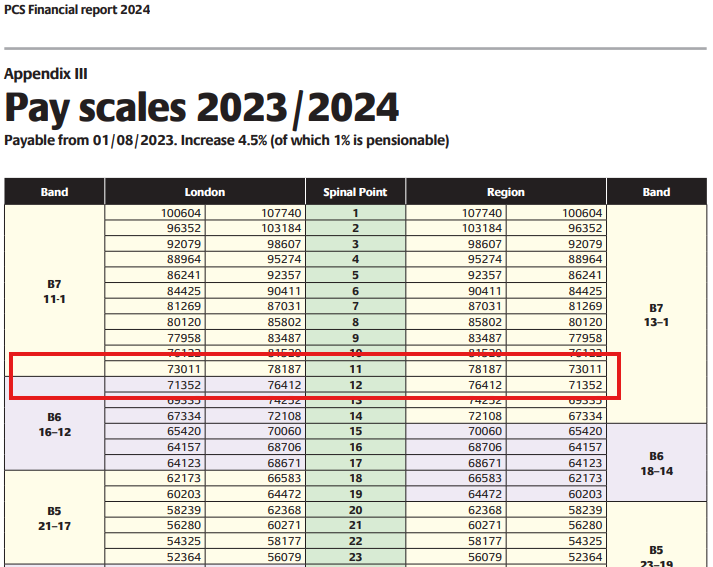
Below are the top salary bands of PCS employees in 2023 from the publicly available 2024 Financial Report. The new ‘super-grade’ (B6a) sits between the top of B6 and within the B7 scale.

The successful candidates for both new positions were coincidently long-term allies of the General Secretary and supporters of Left Unity. They have seen massive pay increases.

For context, the General Secretary is the only staff member who takes home the top B7 band, as Assistant General Secretary John Moloney continues his election pledge to only take the wage of an average PCS member.

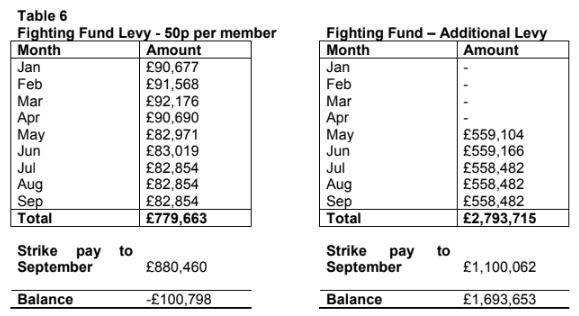
These changes represent an ongoing liability for PCS members, and a permanent increase in the balance of membership subs paid on staffing. A liability, as Table 1 below illustrates which represents an additional 55p plus a month per member than last year. And that’s in August, the number is likely to increase.

(Again, the union’s finances are a matter of public record)

The strategic decision to alter the structure of the union and expand the staffing budget was not scrutinised by the NEC as it should have been before it was introduced.

We were not prepared to endorse this rebalance of the union’s finances away from services and onto new, highly remunerated staff.

It is worth stating that the staff union, GMB were rightly consulted on the changes and accepted them. But there is a significant democratic deficit when the GMB have more of an say over how your subs are spent than the elected PCS National Executive Committee, accountable to you.

The levy

£900k has been spent from the general fighting fund to fund the courageous and escalating action of our FM members across departments. There is consequently an over £100k deficit in that account.

As you can see below, the additional levy is in the black. The only way we can continue to sustain funding for FM dispute is to borrow against this account.

With or without the levy we must find a way to fund current and future action, or we stop it.

Left Unity would simply have us cancel a sustainable source of funding completely.

We have consistently proposed reducing and reconstituting the levy. But if we want to continue to fund and grow these disputes, as the coalition does, we need to fund them.

Where do Left Unity propose to get this money? Or do they want to wind down the outsourced workers action?

Not only would Left Unity have us cancel the levy, but they also want us to fund their unnecessary and unaccountable additional staff burden with no new money.

Increase membership subs?

The unions Finance Committee, which contains a majority of Coalition for Change members, refused to recommend a members subs increase to the NEC. However, the paper presented to the NEC by the General Secretary ignored this and recommended a 5% increase from January.

There was rightfully opposition from Left Unity members at the NEC to this proposal and thankfully the General Secretary on considering the opposition agreed to withdraw the recommendations.

The question for Left Unity comrades now is, how do you want to fund the General Secretaries new staffing structure alongside the – hopefully increased – action of PCS FM workers?

We don’t accept increasing the subs you pay to the union to fund these unnecessary new, super-paid members of union staff.

Keep the Levy vs increases unions subs

The levy and the remainder of the budget of the union, paid for by the bulk of your subs are separate things.

The levy is earmarked for supporting industrial action, members know where that money is going. The rest of the budget is around agreeing a set of spending priorities which are often strategic and political.

As mentioned, the majority of the NEC doesn’t agree the spending priorities of the General Secretary, which have been imposed unilaterally, without scrutiny.

It’s our responsibility as the custodians of the unions finances to continue to argue this point.

‘Tory austerity’?

Left Unity claim that refusing to endorse their budget is akin to ‘Tory Austerity’.

To be absolutely clear, the union is not the same as the Government. The union cannot print money, sell bonds or raise taxes on the rich. Nor is it a profit-making corporation.

PCS is a membership organisation, funded entirely by the subs of its members, many of whom are on the minimum wage.

We don’t believe that such insults or comparisons are correct or helpful. However, as they have now been levelled at us, we offer a more accurate analogy.

Members will remember the government using the pandemic as an excuse to agree wasteful contracts, furnishing their allies in the business world with £m contracts for worthless PPE without any parliamentary scrutiny.

We refuse to allow such unaccountable mismanagement to occur in PCS.

It is, of course also true that Left Unity have consistently voted for cuts in budgets and staff. When the union had to tighten budgets and cut staff when the impacts of check-off hit, did comrades cry ‘austerity’ or claim the budgets read like an employer paper or as claimed a Tory budget. Of course not.

Too honest’

IL supporters made these points in contributions to the debate at the NEC on the 7th. We were criticised in the General Secretaries right of reply and in subsequent Left Unity articles for being ‘too honest’.

The NEC will will revisit the question of the budget at December’s meeting, but no member should expect that NEC members should roll-over and accept unilaterally imposed financial pressures on creating an even greater layer of staff to the detriment of members services.

We will make no apologies for doing so and will continue to be open, transparent and ‘too honest’ about the situation.

A response to the General Secretary and President

In an unprecedented move, the General Secretary and President have today by-passed branch committees to email all members in branches that have passed motions calling for a special delegate conference.

The leaders of the minority faction on the NEC are now openly utilising the unions machinery, paid by members subs, to wage an internal political war against members who seek a different direction in terms of union strategy and priorities.

In response today, many branch committees have rightfully written to their members countering the inaccuracies sent unsolicited to members’ personal email addresses.

We will write more direct responses soon. In the meantime, below is an example of the responses lay reps, who do not have the wealth of the union machinery and full-time officers behind them, have provided to their members today. We encourage reps to use this to respond to their members if they feel it useful.

Dear Member,

You will have received an email to your personal email address today from the President and General Secretary of the union titled, ‘CALL FOR A SPECIAL DELEGATE CONFERENCE BY YOUR BRANCH – THE FACTS’ (not our caps) asking you to mistrust your reps.

Unfortunately, they have made the decision to go over the heads of your locally elected reps and use the unions communications infrastructure, paid by your subs, to wage an internal political war against members who seek a different direction in terms of union strategy and priorities.

Whilst we would rather spend our time as reps, representing and supporting you as members, unfortunately as the email was sent to all of you without right of reply and contained some significant inaccuracies, we only felt it right to respond.

Our branch did pass a motion (attached) at a branch meeting in September. This was done following many other branches of our union across other employer groups and regions passing similar motions.

We passed the motion because we have 3 main concerns which we set out below. The email sent to members claims to refute the facts of the motion. We’d like to briefly set-out why it doesn’t:

1) Pay: The General Secretary and President are content with not challenging the 5% cabinet office pay remit – once again the worse pay offer in the public sector and one which comes with strings attached – job cuts.

Proposals to change this position have the support of the majority of the NEC which you elected last year. Proposals to reject the remit, request negotiations are broadened out to include pay progression, flexible working etc and to begin a national campaign to achieve such objectives have been ruled-out-of-order by the National President.

This much is admitted in the email you will have received. We don’t accept these proposals ‘contravene the rules of the union’ and are happy to supply them to members on request.

2) More union staff on much higher salaries: The General Secretary has made the executive decision, without NEC oversight, to create a new super-grade in the union and more senior roles.

The successful candidates for the 2 new super-grade vacancies are coincidentally current, or recent members of the General Secretaries grouping in the union. These 2 individuals were also, again coincidently, the 2 failed candidates from the last 2 elections for Assistant General Secretary.

The additional vacancies below the new super grade also went to current or recent members of the General Secretary and President’s group in the union.

Disregarding the political connections for the moment. Increasing the number and salaries of paid employees of the union, who’s salaries are paid for by members subscriptions constitutes ‘major financial changes’ and liabilities in any language. And represents a much larger percentage of members subs – including many on the poverty line – spent on staff rather than waging effective campaigns to improve the interests of our members.

All of this done without the consent of the elected NEC or the elected National Treasurer, the Assistant General Secretary.

3) Union Democracy: With no way forward on either question, the only way the deadlock can be broken is for the union to hold an extraordinary conference – conducted online to save the £250k quoted in the email – to put the power and control of the union back in the hands of members and local reps.

Even if you were to accept the arguments in the email, that is surely something everyone who believes in a member led union can support.

Lastly, the email refers to ‘certain organisations operating in the union’. We can assure you that the only organisation which discussed and passed the motion on your behalf was the Branch Executive – elected by you every year. And we did so with the interests of members at the forefront of our minds.

We sincerely hope that this doesn’t dissuade you from continued union membership. This doesn’t change the dedication of reps on the ground to ensure you are represented and supported.

If you have any concerns, please get in touch,


DWP Pay Award: Another kick in the teeth

The long-awaited delegated pay award for DWP staff was published today, weeks after most other departments.

The worst many of our lowest paid members were expecting was for the 5% to be applied evenly across the grades. Across the rest of the civil service the union has largely managed to ensure that the award is either spread evenly, or that our lowest paid members are given a greater increase, such as in HMRC.

Not in DWP.

Unequal, unfair and top-heavy

The headline figure is that the lowest paid AA grade will see an increase of only 4%. Most AA’s to HEO’s on legacy contracts will only receive 4.5% increases, while SEO’s and Grade 7’s will receive a 6% increase to their minimum.

From the Depoartment’s perspective they have at least resolved one issue. Screwing over the most junior grade fixes the problem with the overlap with the AO pay scale… by making AA colleagues even poorer relatively. We’re not convinced this race to the bottom is going to improve staff morale as we are asked to implement the new governments welfare agenda.

A humiliating bonus

Most staff will receive a £90 non-consolidated ‘bonus’. Which for many will be wiped out by tax, student loan repayments and Universal Credit deductions.

It appears you can put a price on all the hard work we are told we are performing, and it can be counted in 2 figures.

Further pain for members

If this insult wasn’t enough, a further kick in the teeth for the lowest paid comes on payday and next April.

Due to the length of time it’s taken to conclude ‘negotiations’, the backdated award will be paid in a lump-sum in November. As with the ‘cost of living’ lump sum of 2023, this will screw with the UC payments that thousands of DWP employees are disgracefully forced to claim to keep up with the poverty line. An issue remarkably left completely out of the union’s members bulletin, much as it was an after thought in 2023.

In April, the National Living Wage is likely to rise. If it does so by the same as last year the DWP will be forced to increase the pay of AA’s and AO’s. And once again, the workers on the front-line of delivering social security will be paid the lowest their employer is legally allowed to get away with.

The role of PCS DWP Group negotiators

This bizarre trickle-down approach to the pay structure is unfortunately not new behaviour from DWP, but it does raise the question what did PCS negotiators argue for?

Showing DWP our hand

When the 5% Cabinet Office remit was announced back in July, the majority of the union’s NEC were clear that it should be rejected and plans drawn up for a national fightback on pay, pensions, flexible working and staffing amongst other issues.

We have continued to argue that we couldn’t accept the lowest pay offer in the public sector, and that rejecting a remit which demanded ‘efficiencies’ (job cuts) in exchange for the money should be a trade union red line.

There was and is the need for continued industrial leverage across employer groups on pay and the other priorities of the membership.

The National President, who is concurrently a DWP Group Vice-President, has ruled out of order each and every motion or amendment supporting this position from the majority.

As a result, union negotiators across the civil service in general and in DWP specifically, went into these negotiations having one hand tied behind their backs by the National President and DWP Group President.

With a tacit acceptance of the 5% remit, and no intention to campaign for anything better, we had lost all leverage and it’s now painfully clear that the DWP smelt blood.

But why is it worse in DWP?

There is no way of sugarcoating this award. Despite the national picture, it is an obvious bargaining failure.

The Group have stated that it could have been ‘much worse’, but that’s little succour to the thousands of members faced with the reality of the final award.

The bulletin put out to members does not criticise the cabinet office pay remit – the direct cause of this pay award, because the Group leadership accepts the remit.

It rightfully rejects the award but offers absolutely no strategy for how we can improve it, because the Group leadership have consistently opposed and undermined any attempt by the NEC majority to devise a strategy to do so.

Finally, the Group use a union bulletin to wage a factional war, wrongly implying that an NEC majority decision would have prevented them from pushing back against an earlier offer.

If DWP management can continue to be such an outlier in the civil service and propose such ludicrous top-down pay offers, it is due to the bargaining and organisational weakness of the union in DWP caused – in part – by decades of poor leadership, not the NEC majority who have no responsibility for these failed negotiations.

No communication with members

The leadership of the DWP Group Executive have long been proponents of secretive negotiations and embargoed communications with members. But this pay round has been excruciatingly bad. There hasn’t been a single meeting since the commencement of pay negotiations with members and not a single branch bulletin providing an update, not even a holding message.

Secret negotiations and embargo agreements only benefit the employer, proven again by this years’ experience.

We need a union and a DWP group executive who will consult members throughout negotiations and communicate openly about their progress. Ensuring members could be mobilised to exert pressure on the employer rather than being treated by the employer and union alike as a passive observers to their fate.

Hybrid Working, Saturday opening, pay progression…

As the NEC majority has attempted with negotiations around the initial Cabinet Office remit. Other than tradition, there is no reason why these discussions have to be kept to pay.

If the employer claims their hands are tied on the remit, we should be demanding that negotiations are widened to include things like commitments on allowing hybrid working for all staff, phasing out Saturday opening, and re-introducing pay progression up the scales. Things we know the Department can change and all things that are currently deprioritised on the union’s bargaining agenda.

The current unimaginative and conservative approach to bargaining, done entirely on the employers’ terms is not good enough.

We need a Group leadership who understand this.

Where are the Labour ministers?

The Labour Party promised to ‘Make work pay’.

Does the Secretary of State and DWP ministers support what is being done in their name? The largest department, with the greatest amount of operational staff in the lowest grades being paid the minimum wage? Continuing to rely on Universal Credit to make ends meet?

We’d hope not and would hope the Group Executive Committee are targeting Labour ministers about this both directly and through the PCS Parliamentary group. We also hope Labour Party members and constituents are making this hypocrisy well known. There appears to be a desperate need for some goodwill towards the government at the moment.

The problem is bigger than DWP

This ultimate responsibility for this pay award and the pay awards across the civil service, the vast majority being the lowest in the entire public sector lies with the employer.

But at every step of the way the union has been lacking.

Because the General Secretary wanted to tacitly accept the pay remit, run-out live ballots and refuse to re-ballot, and because the National President has undemocratically blocked any attempt by the NEC majority to put forward an alternative strategy, our members have to put-up with the lowest pay-rise in the public sector and the government, and employers across the civil service have had a free-ride to implement the remit as they see fit.

Because the Group Executive has failed to stop the unions organisational rot in the DWP, leverage with the employer has waned.

Because the unions negotiators in DWP refused to open-up negotiations to the membership and prevented them from being involved, we were neutered from the very start.

What can we do?

We desperately need a new leadership and a new strategy. But in the immediate term we need to stop the NEC minority from blocking such a strategy.

That’s why we are calling on all branches to pass motions calling for a Special Delegate Conference, so members and reps start calling the shots, not a minority of the NEC.

Latest from the NEC: A victory for the National Campaign but a defeat for union democracy

At the initial NEC meeting of the year in June, the proposal of the NEC minority, led by the National President was not to hold an NEC meeting until the end of July. A whole 9 weeks after the national ballot results and the subsequent National Conference of the union.

The Coalition for Change majority agreed, that considering the ongoing political events and that the ballot mandates that we had secured were slowly running out of time, that it was imperative to have one earlier. So, invoking our right under the Standing Orders of the NEC we called an emergency meeting.

In calling the meeting we requested for this NEC to cover the following key issues in-line with both conference policy, the joint programme we were elected on and the key priorities of the membership:

  1. Progressing the National Campaign following the General election in line with Conference Policy.
  2. Implementing urgent, practical steps to support the sacked HMRC reps.
  3. Replacing the outgoing NEC’s Organising Plan which was rejected by delegates at conference.
  4. Beginning to improve the substandard legal services provided to reps and members.
  5. Rejecting the General Secretaries decision to spend members subs on huge pay-rises for senior Full-time Officers.
  6. Ensuring that the unions TUC General Council nominations reflected conference policy and the views of the majority of the union’s leadership.

For most of these, Coalition for Change NEC members had submitted amendments and motions (to be found here), outlining the direction forward and instructing the General Secretary accordingly.

In calling an emergency NEC, the Standing Orders outline that the purposes of the meeting should be summarised in the request. This was done.

Perhaps naively, we thought the National President would abide by the Standing Orders. However, immediately after opening the meeting he stated that he would be ruling the vast majority of our agenda out-of-order on the basis that he considered that only the National Campaign should be discussed.

As discussed in the report of the first meeting, the President continues to claim they can make any ruling and that a 2/3 majority of the NEC is required to overturn it. Despite having a significant majority, the Coalition does not have 2/3rds and so despite challenging the ruling on principle, it was upheld.

Your support in challenging this behaviour

Members and activists should be under no illusion. The Left Unity minority, having lost the election, are using purposeful misinterpretation of bureaucratic process to prevent the majority from progressing union business in support of the membership. It is, as was pointed out at the NEC, akin to the behaviour of the old right-wing moderate group in their attempts to prevent the then left majority from taking forward policy on the NEC.

We appeal to Left Unity members, including those on the NEC and specifically the new, younger members: Is this the sort of behaviour you came into Trade Unionism to enable and defend?

  1. Progressing the National Campaign

Graciously, the National President did allow the meeting to debate the national campaign.

Since the national ballot results and the union conference, there has not been the ability to take forward policy on the national union. The Coalition for Change, backed by Conference policy, knew activists and members were concerned about the inaction. This was backed-up by a timely email from a DEFRA branch to the NEC decrying the inertia and demanding their members be able to fight.

Taking this all into account, alongside the result of the General election, we submitted a comprehensive motion on taking the campaign forward which can be found here (Motion 2).

In summary, the motion sets out a timebound strategy of placing our democratically agreed demands on the government, allowing time for consideration, and ensuring that Labour understand that we are prepared to act if no meaningful ground is given.

This strategy or no strategy?

In contrast, the General Secretary’s paper offered no industrial strategy. As you can see, the recommendations asked for more consideration, further forums and in as much as there is to be communication with the new government it is to simply ask for more meetings.

This strategy amounts to inertia at a time that we have a duty to grasp the opportunity and put some timebound demands to the government, using the leverage of existing mandates and the threat of new ones.

Give Labour time?

We are glad that Labour beat the Tories. But we are not complacent, are acutely aware of the watering down of their commitment for workers rights and refusal to make commitments on public sector pay. We also don’t have short-memories and can remember the previous Labour administrations pay policy and the whooping of Labour backbenchers when Gordon Brown announced 100,000 civil service job cuts.

There is a need to put the new government to the test right away. They are already publicly dealing with the BMA, having been forced to do so by their ongoing ballot and strike action. They have said they want to negotiate with the unions and made the point during the campaign when confronted on the question.

At the NEC, Left Unity members were divided on the issue of how much time Labour should be given before we act, but they all wanted to allow some extended honeymoon period. The Coalition was not: The government has the ability right now to begin negotiations around the upcoming remit – if they are willing to then good, but if not, we must be ready.

When it came to the vote, the General Secretary’s strategy was voted down and the Coalitions Motion was passed. We will ensure as much as possible that the instructions are carried out.

2. Supporting sacked HMRC reps

Many members, particularly in the revenue, will be aware of the grotesque behaviour of that employer in sacking trade union activists at Benton Park View.

For both the branch and the Coalition, the response from the leadership, encapsulated by the General Secretaries paper to the NEC, has been too little, too late.

The Coalition submitted an amendment to that paper (Amendment 2), outlining practical steps which should be taken to support these members. Steps which were supported by the HMRC branch. Namely:

  • That steps would be made to move to industrial action.
  • That materials and speaker’s, chosen by the HMRC GEC and BPV Branch should made available.
  • That the NEC should support a mass lobby of key HMRC buildings.
  • That the Geneal Secretary report back to the next NEC to discuss escalation.

Despite being supported by the majority on the NEC, the National President ruled these amendments out of order.

We were left with the decision of either supporting or voting down the General Secretaries paper, which despite being wholly inadequate did commit union resources to the campaign. Obviously in that situation we voted to support the paper.

The decision of the President will no doubt be met with glee by HMRC management, even if it’s met with despair by our members and reps.

3. Replacing the rejected Organising Plan

National Delegate Conference rejected the outgoing NEC’s organising plan.

While growing in actual members since 2020, with a recent dip, union density, which is the main metric we measure our industrial strength has plummeted since 2015.

We know that we can’t be a proper representative body with these numbers and understand that we have much less leverage in negotiations if this situation continues.

The outgoing NEC’s organising strategy fell because it was largely a copy and paste job from previous years, attempting to do the same things again expecting different results. With the dire situation the unions density is in, we don’t have the luxury to continue this way. An alternative strategy is required.

While fixing the situation is not going to be done overnight, we need to start with the right objectives. Continually telling ourselves that 50% density will be enough is a lie. That is derecognition territory and does not provide enough leverage for us when we take strike action. Equally, while lip service is paid to joining the two, we do not treat bargaining and organising as co-dependent forces, and this certainly was reflected in the rejected Left Unity organising strategy.

On that basis the coalition produced a motion (Motion 3) to commence the development of a new strategy.

Again, despite being supported by the majority on the NEC, the National President ruled this motion, key to the future of our union, out of order. The union continues not to have an organising strategy.

4. Beginning to improve the substandard legal services provided to reps and members.

Members and reps alike will know the state of the union’s legal services. In the hustings during the GS and AGS elections it certainly was consistently raised. Advice is untimely, sometimes inaccurate and far too many cases are rejected.

As a result, the coalition ensured that improving legal services was a central plank of our joint platform.

We wanted to make some quick wins for members, so we submitted a motion to the NEC (Motion 4) instructing the General Secretary to:

  1. Ensure that arrangements are made to ensure claims are responded to and regular updates are provided.
  2. That branches are to be notified that they can appeal decisions they think are wrong to the Senior Officers Committee of the union.

In future we also want to discuss the SLA we have with Thompsons and whether it is fit for purpose as well as moving towards a more risk tolerant and combative position when it comes to legal cases, especially novel ones or ones done on matters of principle where we might want to test case law.

Again, despite being supported by the majority on the NEC, the National President ruled this motion, so important to the welfare of our members out of order. We will attempt to bring it to the next NEC.

5. Rejecting the General Secretaries decision to spend members subs on huge pay-rises for senior Full-time Officers.

The NEC is constitutionally empowered by Supplementary Rule 8.3 to approve all staff appointments and terms and conditions.

Last month the General Secretary announced significant changes to the unions staffing structure without informing the NEC or the wider membership. These changes include:

  • An increase of the total number of Full-time Officers (FTOs) by three.
  • The possibility of voluntary redundancy, with posts being backfilled.
  • The creation of a new ‘super grade’, 6A, without advising anyone on how the vacancy process for these new positions would be filled.
  • The possibility of some NEC sub-committees, and the Assistant General Secretary’s office having less or in some cases no formal FTO support.

We are in principle against more of members subs being directed towards staffing costs, especially if they are directed to creating a new band of super-paid full-time officers, paid well in excess of the salary of an average member.

According to the latest pay scales (page 66 of the 2024 Financial Report) these new staff will be paid in excess of £76k a year from membership subs which would otherwise go on things like strike-pay.

But even if you don’t share this principle, the changes will increase the proportion of income spent on staff costs. At 34.5% of income, the union is already in breach of 2021 conference motion A9 and the financial objectives of the union, which both rightfully ensure that staffing costs are kept at or below 33% of subscription income.

The potential for the AGS’ office and NEC subcommittees like Bargaining and Organising to be stripped of FTO support, presumably in favour of centralising power in the General Secretaries Office, is also concerning from a democratic perspective and is likely to deepen the ‘Jobs for the Boys’ culture endemic in the trade union movement in general and PCS in particular.

If there is any evidence more damning for that it will be the appointment to the new super-grade positions of the failed candidates in the 2019 and 2023 Assistant General Secretary elections, while John Moloney, twice elected, continues to take home the average worker’s wage.

We submitted a motion (Motion 5) to stop this, which was again ruled out of order by the National President.

6. Ensuring that the unions TUC General Council nominations reflected conference policy and the views of the majority of the union’s leadership.

The National Executive Committee has the duty to agree who from the union sits on the TUC General Council each year.

This year the General Secretary produced a paper which made a recommendation to the NEC that she should take the seat.

Considering the behaviour of the National President in this and the previous NEC, the Coalition for Change were not confident that the democratically decided positions of the National Union reflected in both National Conference Policy and the majority of the NEC would be faithfully represented at the TUC if this was agreed.

We therefore opposed this recommendation and submitted an amendment to the paper (Amendment 4), as is our right, for the Assistant General Secretary, himself with a mandate exceeding that of the General Secretary, to sit on the Council for this year.

The President, disgracefully ruled this amendment out of order, ruling that it was his opinion that the rule stating that the General Secretary should be on the TUC congress delegation meant that the General Secretary should also always hold the GC position. An outrageous, intentional abuse of his power.

If this was the case, why each year does the recommendation for the General Secretary to sit on the Council come to the NEC?

Clearly, in this situation we voted down the recommendation that is be the General Secretary. This left us with no nomination for the position.

In an extraordinary act, the President then ruled that *despite* being voted down by the NEC, he was simply going to ignore the vote and state that he was deciding against the will of the NEC that the General Secretary shouldn’t be the unions candidate.

We believe this goes one step further than the previous rulings. This is not the behaviour of a democrat. It is tyrannical behaviour which demonstrates a particular arrogance and contempt for union democracy, the votes of the members and the rules of the union.

What next?

Members and activists from all factions and none should be very clear about this. The semblance of democratic due process of the Mark Serwotka years are over. If you think this behaviour is beyond the pale, please make your voices heard.

You will not find a report like this from the central union, who’s staff is still controlled by the General Secretary. We were elected on being as transparent with the membership as possible, which is why we think it’s important you can read as much of the discussion and the relevant papers debated.

There is a face-to-face NEC next week where the Coalition for Change will continue to push the priorities above and those of our joint programme. We will of course report back.

I the meantime, please consider joining us.