
Doesn’t The DWP Ballot Mean That Left Unity Isn’t As Bad As You Claim? No.
We’re tempted to leave it at that, but no doubt a Left Unity loyalist will demand proof positive of the No. So here goes.
Firstly, we must recognise the very narrow focus of the demands set out in the ballot: use available funds to temporally move staff off the min wage and introduce some pay differential between AAs and AOs etc. We say temporary as LU admit that with the monies available it means that in 2027 we will probably be back in the same mess as we are now; that is staff will be caught up by the min wage again.
Then there is the timing; right before AGMs and the GEC elections. This is standard procedure for LU, begin a dispute/ballot/campaign before/during elections. So the ballot is partly an election ploy.
All the leading LU leaders in DWP, as far as we can see, are on 100% facility time. That materially cuts them off from the shop floor. Despite this insulation though they are susceptible to membership pressure. So they recognise that year after year, more and more people in the department are clustering at the legal minimum wage. This is felt by them. The ballot is part reaction to this.
Probably equally important however is that they are personally affronted by the disrespect that senior managers in DWP show in dismissing the arguments put forward by them – after all they are important people! So the ballot is part about reasserting that the leadership should be respected.
We would do things differently if we were in charge – we would aim for a different type of a dispute – one that would tackle head on the systematic problems we face in DWP:
• end the multi-tier work force
• no Saturday working or late night working unless overtime is offered
• guaranteed progression for HEOs and above;
• arrangements put in place so that AAs are always above the min wage – on a real living wage – and that there are real pay differentials between AAs, AOs and EOs.
We need a leadership that looks beyond the next few months and fights for a long-term settlement that respects the work we do.
If you want a union that fights for that rather than a temporary fix, vote for the Independent Left and others in the 2026 DWP GEC elections.
Tag Archives: ballot
A Ballot Ready NEC?
Left Unity (LU) does not want a strike ballot over pay and other critical issues.
Their reluctance comes from:
• low union density (the proportion of members to non members), making collective action less effective. They believe the union is weak.
• LU is intent on keeping good relations with the Labour Party, fearing that a ballot or strike might strain those ties, and their hitherto ineffectual national talks. (Labour Ministers are well aware of the huge gap between the General Secretary’s bombastic claim that she would hold their feet to the flame and the total absence of national campaigning since they entered Government last year).
• They prefer a quiet life presiding over weakness than the busy and stressful life that is required to turn the union around and fight for improved terms and conditions.
LU’s mindset means that it responds negatively and with hostility to members and activists who push for more union ambition, a meaningful bargaining agenda, and for stronger action. Rather than engaging with members and activists, seriously challenging, for example, the lack of progression pay, they are wholly focused on maintaining internal control of PCS and preventing rivals from gaining influence. In the process they abuse the structures of PCS.
Whatever criticisms one might make of the British Medical Association’s leadership, the current contrast between that union and PCS is stark.
They have a long term agenda, most notably restoration of the value of their pay; activists won that agenda and the leadership have repeatedly called action on that basis (delivering the highest pay awards in the public sector), having carefully explained the reasoning and need for restoration to members; membership has risen as a result. Doctors know that the BMA is serious about the demands.
Government has been repeatedly told that the BMA needs clear proposals for rebuilding resident (formerly “junior”) doctors’ pay – not necessarily in a single year but delivering on the demand. In face of foot dragging by the Tory and now the Labour government the BMA shows a willingness to fight, they have a campaign plan, and they are always looking to build their membership.
PCS’ “left wing” leadership, however, projects a different image. ‘We implore the government to review the roadmap and work constructively with trade unions’ so says the President after the announcement that many of the provisions of the Employment Bill won’t be enacted until late 2026, early 2027. Yet he doesn’t have a concrete plan for what the union will do if ministers refuse to budge. This is not only around the Employment Bill but in fact on all things. PCS tends to beg, not fight. This gives the public impression of a union acting more as a humble petitioner than as a force ready to confront power.
The General Secretary writes ‘“… government hostility to public service workers have made it clear that we can’t rely on employers or ministers to do the right thing …. It’s only through collective strength that we can shift the balance of power.” So, if the Government is hostile, how does our LU General Secretary plan to deploy our collective strength? She promised to hold their feet to the flame, how and when does she plan to do so?
Not a word from her or the President or the LU NEC majority on such matters. LU hopes by playing nice this hostile government will give us concessions, and we will not have to use our collective strength. The results of their approach is obvious: members heading for standstill or below inflation pay awards; no pay progression; no return to national civil service rates of pay; no pay restoration; insistence on office attendance; job loss. If we want to make a difference as a Union we have to have the confidence to act like one.
PCS is a minority union in most workplaces. More members would indeed bring more negotiating leverage. An ambitious recruitment plan to bring in tens of thousands more members, backed by real resources, will boost our ability to impose accountability on ministers and employers.
The NEC has supposedly adopted a “ballot-ready” strategy – after wasting all of June and July – and arranged members’ meetings. But months of inactivity mean members approach these meetings unprepared, with no strike plan to consider, and little momentum to carry forward. LU are secretly hoping to blame members and so avoid holding the ballot mandated by the 2025 PCS conference.
IL Statement On DWP Elections
At present, the joint Independent Left/Broad Left Network candidate standing for DWP President, Bev Laidlaw, will be omitted from the DWP Group Executive Committee ballot paper on the stated grounds that she did not accept the nomination within the deadline.
Bev does not agree with this view and decision. Without going into all the detail here, Bev indicated her acceptance within the deadline, stating “please find attached my election addresses for DWP Elections 2024; DWP Group President and Ordinary GEC member.” On any reasonable reading a candidate stating that are attaching election addresses and identification the posts they cover is a statement that they do accept nomination for those posts.
Supported by IL and BLN colleagues (who are also standing as part of the Coalition for Change in the NEC elections), Bev has challenged this decision, although the “procedure” allowed for challenge is not one we would recommend and the HQ decision, as it stands at present, will mean that the LU candidate will be elected unopposed.
The wider view we take, and that Bev has expressed, is that trade unions should favour the maximisation of democracy, reduce obstacles to candidates standing, and promote contested elections rather than omit candidates for reasons unconnected to the key issues of whether a candidate is in membership, is a member in the relevant constituency, has been properly nominated, and has accepted nomination. Going forward after the election, we will therefore be looking to ensure PCS’ election arrangements reflect these fundamental democratic principles.
In the here and now, it is crucial that everyone of us, who wants change in our union, who is serious about winning on pay and wants democratic, accountable leaders, redouble our efforts to vote for and campaign for BLN/IL/Change candidates in Group and National Executive Committee elections.
You can read our programme here, and see the candidates we endorse here.
Vote for change.
PCS National Campaign Strategy: Sabotage or Incompetence?
The PCS NEC met last week to discuss last minute proposals from the General Secretary for this year’s national campaign strategy.
Observant members will notice that last year’s national campaign, which we were told was merely ‘paused’ has, as we predicted, been swept under the carpet, never to be spoken of again. But as a reminder – we settled on the lowest pay offer in the public sector and a £1500 bonus which the failed candidate for Assistant General Secretary told bargaining units to accept being paid pro-rata’d.
The NEC decided on a pay-claim and a national consultative ballot for strike action, which they have described as a ‘survey’, which would be carried out over 2-weeks from the 20th of February, which may or may not result in a disaggregated Civil Service statutory ballot before May.
Ballot timetable
To put this in context, branches were asked to agitate around a consultative ballot on pay, which would commence less than a week after it was announced, would last only 10 working-days and who’s demands have been sprung on members and activists at the last minute without any consultation or rationale.
The formula of a short, rushed consultative ballot with little preparation time and minimal rank-and-file engagement, followed by the potential of a statutory ballot if the response is positive is paint-by-numbers Left Unity industrial strategy. But this timetable is particularly galling.
Such a rushed ballot strategy presents 3 key issues:
Firstly, the incompetent administration of the ballot is already causing problems. From members not being sent the links on the day the ballot started, to being asked for their National Insurance Number rather than membership number to vote and hosting the ballot site on a none ‘https’ secure server. All are unnecessary barriers to participation and will reduce turnout.
Secondly, a predictably poor turnout does not provide an accurate measure of members feelings. It also provides those who would rather not move to a statutory ballot the ammunition to argue that members are not sufficiently prepared for action. The leadership have used this argument previously not to move to a statutory ballot and we should be conscious this may be the case again.
Thirdly, running potentially 2 ballots in such a short space of time is a recipe for unnecessary confusion and fatigue among members and activists. Members are potentially being asked to take part in two ballots, asking the same question within weeks of each other, and activists are being asked to turnout the vote twice over. As both ballots are conducted in different ways, more confusion is likely.
The Academic Study
The foundation of the pay claim was an academic study commissioned by the union on pay trends in the civil service overtime, but specifically since 2007. For transparency, we attach the study at the bottom of this article.
This was received by the union in January, but not shared with the NEC until just before the meeting and not shared with branches until this week.
The study illustrates the serious loss in real-terms wages since 2007, summarising that just to restore real-term earnings to 2010 levels, an average of 35% pay increases at grades AA-EO would be required.
This figure does not surprise us. Independent Left comrades both in branches and on the NEC have consistently argued that pay restoration is a key demand and that to continually carry over the same pay claim year-on-year while pay shrinks, is a tacit endorsement of real term pay losses. Historically, this has been met with ridicule, with the leadership stating that members would find a 35% pay demand to be absurd.
Pay Restoration
They say good things come in groups of 3. During the last years national campaign, the union adopted 2 tactics we had been advancing for years. Namely selective/targeted action in areas which were industrially disruptive and a levy on members subs to ensure such action could be supported.
This year, the NEC has rightfully adopted the demand of pay restoration, although one could argue too little too late considering years of real-terms pay degradation.
Pay restoration is a key demand. It’s not an arbitrary percentage rise which has no basis in the material reality of members experiences, and which isn’t tied to the increase in the cost of living. It’s asserting the principle that workers’ salaries should at a bare minimum always keep up with the cost of living. It is good it’s finally been adopted.
Lowest paid left out
Why then, hasn’t the £15/r under-pin for our worst paid members been uprated? £15/hr was in the 2022 claim and since then, we’ve had historically high inflation. It would be excellent if we simply won on pay restoration, but if we don’t achieve that, the point of the underpin was to act as a separate bargaining point for our lowest paid.
They have been sadly ignored by this claim.
Hybrid working
Many thousands of our members have since the end of the pandemic, little choice by to attend the office daily, despite proving during the pandemic they were able to do much of their work from home.
One of the key issues for hybrid workers is the move to increase office attendance from 40% to 60%. This is a widely and deeply held grievance, which if included in the claim would help to increase participation.
For non-hybrid workers a specific demand advancing the principle for flexible working where possible should be included.
Exclusion of FM workers
Once again outsourced and facilities management workers are left out of the claim. We understand this pay claim is for Civil Service Workers, but there is no reason why the demands we’ve made nationally for our outsourced workers should not sit-beside them in a joint campaign.
As it is we have a national campaign, into which most of the union’s effort is focussed with a much more secondary and in many groups like the DWP, non-existent campaign for Facilities Management workers. Workers which hold significant industrial power in our workplaces and who through a coordinated campaign could bolster leverage for all members.
So, incompetence or sabotage? Or a mixture of both?
The question for us is, is this strategy designed to sabotage the campaign from the start or is it simply a poor, incompetent plan? We will give the new leadership the benefit of the doubt and go with the latter, but there may well be members of the leadership faction who do have the inclination or capability to fight an industrial campaign.
What is telling, is that numerous NEC members have admitted in various forums that they hadn’t even read the study before voting on the claim, preferring to simply accept the claim as presented by the general secretary. Whatever your faction, the role of an NEC member is to scrutinise decisions based on the total amount of evidence. It is depressing, but not surprising that NEC members do not think this is important.
Regardless, we have a lot of work to do over the next weeks to ensure the maximum membership turnout. Vote Yes to industrial action.
What’s the alternative?
If the aim is to have a live mandate by conference in order to be able to take action in a timely fashion during this year’s pay round, we should have begun the process much earlier, on the safe assumption that the pay-remit would not be acceptable to us.
As we are where we are, we believe a better option would be to use the coming weeks to continue to ensure the foundations in branches are prepared for a statutory ballot, not to agitate around a superfluous consultative ballot.
In terms of the claim, pay restoration is good (but needs to be explained to members), but the refusal to uprate the underpin and the omittance of one of the key workplace issues of the day – flexible working – are serious oversights which could have been caught if the process wasn’t so rushed or we had a different leadership.
Independent Left at PCS Conference
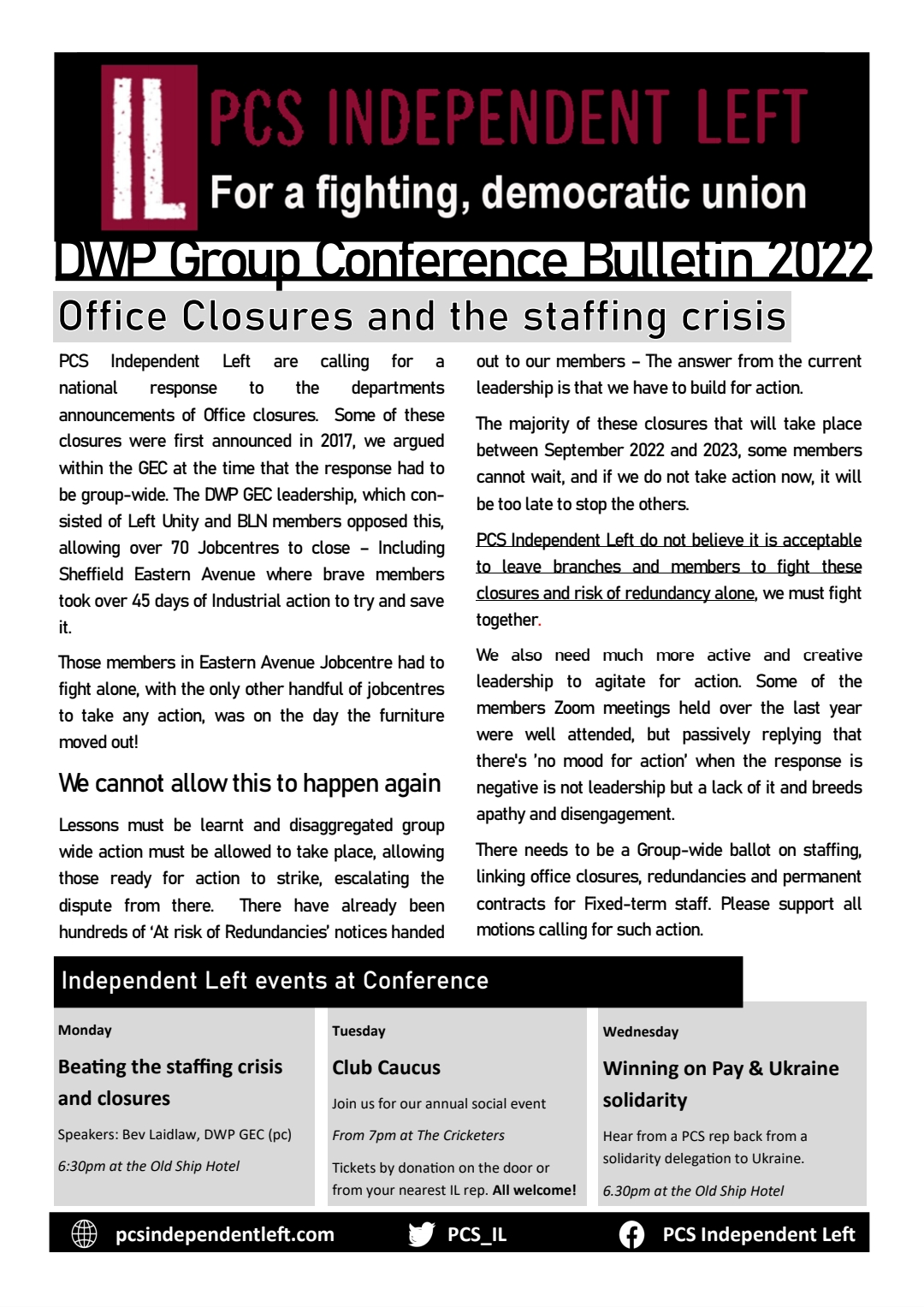
PCS Independent Left members and supporters hold organised interventions at Group and National conference. This year our members were responsible for writing and submitting motions, including but not limited to, proposing a campaigning strategy for the permanence of fixed-term members, calling for the future national pay ballot to be conducted on a disaggregated basis, for Solidarity with Ukraine and to end the unions unfair, unequal subs
We are the only group in the union to produce daily conference bulletins, responding to the debates and providing a perspective on upcoming motions. We also hold conference fringe meetings and were the only group to organise a conference social event.
The bulletins we produced this year are included below.



 PCS Independent Left