“If you think you’re not getting what you’re worth – come out”

Civil service security workers outsourced to G4S have been on strike for improved pay, sick pay and annual leave, and against a two-tier workforce. This picket line interview with Carly Wade, a PCS rep at the Cabinet Office in Whitehall, is republished with permission.


We have a two-tier pay system here. We have a lot of people who are just on the London Living Wage, and some of us get more. We want one pay tier. We don’t want anyone to be without sick pay, we don’t want anyone to have a lot less holiday. We all do the same job – we want everyone to be equal.

We’re asking for a certain amount above the London Living Wage for those on that; for a percentage in line with inflation for the rest of us; twenty five days sick pay for everybody; and thirty days holiday for everybody. We need the two-tier system to stop.

Our colleagues who have no sick pay at the moment, for instance, obviously have to come to work unwell. And then if a member of someone’s family has Covid or flu, say, it’s a knock on effect for all of us.

I do get sick pay, and my salary is better, but a lot of my colleagues don’t get those things. The reason is I was previously employed by the civil service, and I have civil service terms and conditions. Our workforce has been outsourced six times since 2007, and each time the company has brought in a certain number of people. So the number who were directly employed constantly falls. I don’t think there’s even half of us now who are on those relatively decent terms and conditions.

Even those of us on civil service conditions haven’t had a pay rise in seven years.

I want to underline that outsourcing is the problem. The relative benefits the civil service brings, in terms of pensions, for instance, a certain amount of sick pay, a certain amount of holiday pay – these companies don’t bring that. They bring people in, sometimes on zero hours contracts; so you’ll see someone for seven hours one week and then fifty hours the next week.

We’re against outsourcing. We believe that government buildings, especially, shouldn’t be outsourced. The quality of the job done also goes down. You can see that with the people they’ve brought in to replace us, who have had no real government security training. Meanwhile, even at normal times, when people have no job security, when they’re scared to go sick, when they feel they have to do overtime, or won’t get annual leave approved, that has a huge impact on people’s state of mind too.

When are you on strike till?

We began on the 28th, and we’re on strike till this Sunday [10 November]. Monday we all go back to work. We’re picketing Monday to Thursday both weeks, 8-10am.

There’s no movement officially, but we know, and our friends in the building have confirmed it, that this is not sustainable. They’ve brought people over from Northern Ireland, they’ve had to pay for their accommodation, for their food, for taxis. Management have had to come in at 6 every morning, which never happens! I do believe we are going to win. Once we stop on Monday, we’ll announce our next round of dates. We won’t stop till we get what we deserve.

You said this is the first time you’ve been on strike. How does it feel?

Yes, this is the first time [security at] 70 Whitehall [the Cabinet Office building] has been on strike. Do you know what – it feels quite empowering. It really does. There’s a lot of bullying going on with, in this company especially. People are not treated well; they’re treated like second class citizens in a way. They didn’t think we would pull this off. I’m a very new rep, my colleague [fellow rep Mohammed Miezou] is a very new rep, and this is the first time we’ve done anything like this – but everybody has come out on strike, every single member has come out. Everybody is so pumped up for this; everyone is here at 7 o’clock in the morning, everyone has got their whistles and is ready to go.

I’ve never seen unity like this strike has brought us. Everybody is so loyal to one another. It’s actually been quite emotional to see everyone come together.

What would you say to other workers who are thinking about going on strike, or even just joining a union?


Know your worth. Know what you deserve. I’d recommend everyone join a union. I’ve been here 19 years, and in the union 17 or 18 of those. PCS have been fantastic; they’ve given us the support we’ve needed, materials we’ve needed, they’ve been on the phone at 11 o’clock at night…. We’ve also had good support from our directly employed PCS colleagues, who’ve joined our picket lines, come and clapped us, brought us chocolates, and found other ways to support us.

Wherever you work, everybody needs to stand up for what they believe in. If you think you’re not getting what you’re worth, then come out! They can’t run businesses without their workers.

What would you expect from the new government?


Well, unlike our civil service colleagues, our ministers haven’t come and supported us. They’ve not even come out to speak to us and find out what our issues are and why we’re on strike. We find it extremely disappointing.

What we want to see from this government is insourcing. We’d like to see contracts like this insourced. Companies like G4S and similar, they don’t have anyone’s best interests: it’s all about profit. You’d get so much more loyalty and commitment out of your workforce if you brought them back in house and treated everybody with respect.

What kind of solidarity do you want?

It’s lovely to hear buses and lorries coming past and beeping. That and people joining our picket lines and clapping gives us such a boost. It’s tiring blowing whistles for three hours, so it gives us a real boost to get support from others. People can also promote our stuff on social media, and contact their MP. And promote the message: we need insourcing of all government contracts. 

You can read more of Sacha Ismail’s coverage of PCS here: Union officials should be on workers’ wages
Report of the 15th January PCS NEC

The agenda for this meeting was incredibly packed due to the NEC repeatedly not getting through business and having items rolled into the next meeting. Despite this, the NEC only ran for a half day from 1:30-5:30pm. This resulted in us only getting through two substantive agenda items – the National Campaign report and the National Disputes report. The rest of the meeting was taken up by Rule 10 complaints.

The meeting opened as every NEC meeting opens; with the Record of Decisions from the last meeting being voted on. Coalition for Change comrades attempted to move amendments to the RoDs regarding motions from branches about the Special Delegate Conference. Unfortunately, these amendments were ruled out of order by the President. This presidential ruling was challenged by CfC comrades but to overrule it would require a 2/3rds majority which wasn’t met.

National Campaign

Next, we moved onto the national campaign paper and in a truly shocking turn of events, the President announced that a motion submitted by the Coalition for Change was going to be allowed to be heard as part of this agenda item! Before the motion could be debated though, we listened to the General secretary’s leadoff on her paper. This took quite a while considering there were no recommendations in the paper, which was mostly just an update on the various unfruitful meetings that have happened since early December. What does seem to come through loud and clear from it, is the complete and utter lack of genuine engagement we are getting from the Cabinet Office. The paper expressly states they ‘have no plans to move towards sectoral collective bargaining for the civil service’ and ‘did not believe any agreement was possible’. On the question of facilities time, the Cabinet Office is apparently ‘open to reviewing its guidance’ but we wouldn’t hold our breath for a positive outcome from this review given previous experience. All in all, the change in government has certainly not resulted in any kind of step change when it comes to their own workforce. In fact, on pay the government have outlined recommendations for a 2.8% rise this year, very close to the current and projected rate of inflation this year and much lower than the unions demand to make-up for the dramatic real-terms pay cuts we’ve experienced since 2010. All that talk from Labour of ‘a new deal for working people’ just seems like a distant memory now.

After the GS led off on her paper, she indicated that she was in support of the motion submitted by CfC comrades. This motion seeks to put us on a war footing and lays out a set of actions which aim to get us ready to win a resounding yes vote in any future ballot. While we find it hard to trust any Left Unity support – and Independent Left comrades openly suspect political manoeuvring was at play – the unanimous vote in favour of this motion is still a positive step forward for the national campaign.

Not least of all because amongst other things the motion calls for;

  • NECLOs to urgently seek the convening of EC meetings for their areas, to report on discussions with the Cabinet Office and to make clear the NEC view that significant progress is unlikely without a serious fight.
  • All NECLOs to seek input from their areas on what the demands should be, the current mood of members, and what steps lead reps believe should be taken, either at national or delegated level, to build the mood for a serious dispute.
  • Particular attention to be paid to any views on what resources the lead reps across the union believe they need to deliver an overwhelming “Yes” vote in a ballot, and likewise views on how to build for and support the inclusion of devolved and commercial sector areas (as per A315 passed at ADC).
  • A comms strategy and calendar to be devised and agreed by the Senior Officers Committee reflecting the union’s demands, which will include supporting Groups to speak to their members via well-advertised online meetings.
  • Organising materials to be prepared and circulated to branches ASAP.
  • The General Secretary to work across the TUC, Public Sector Liaison Group and other affiliated forums to build the appetite for action across the movement.
  • An extraordinary NEC to be convened in February to discuss feedback and the latest position in negotiations, and to gauge the mood among members and judge the requirement for a statutory/indicative ballot and how and when it should be conducted.

During the debate members of LU seemed to insinuate that the reason they were supporting the CfC motion is because it lays out much of what the GS had already tried to implement previously and we could have been doing months ago. This is likely a foreshadowing of attack lines which will be used in the upcoming NEC elections so in order to dispel any myths that might start circulating, it’s worth reminding ourselves of the previous recommendations put forward by the GS in key NEC papers

  • May 2024: The NEC to take stock of new conference policy, our political leverage and the outcome of the General Election before determining a way forward for the National Campaign
  • July 2024: More consideration, further forums and meetings with the new government
  • August 2024: Welcome the concessions won so far, pause any plans for industrial action at this stage, pause the levy, engage in further talks at delegated level to try to secure more money than the 4.5% pay offer on the table.

Absolutely none of this outlines any kind of serious industrial strategy.  

What was also worth noting during this debate is after the failure of the previous, LU, NEC’s ballot in May 2024, data was collected which could be used to analyse strengths and weakness at branch level, to assist in building for the next campaign. The General Secretary informed the NEC in July that ‘those conversations will now begin’. But they don’t seem to have done? We ask reps and members, have FTOs spoken to you about your results and what you could do next time? Whether this inaction is a result of Heathcote’s PCS being more occupied by shifting staff around for political purposes, or something deeper, is unclear.

The Coalition for Change motion agreed by the NEC on Wednesday makes clear that engagement with reps about what could have been better last year, and what they need to win this time, is essential. But in a further sign that the General Secretary is more concerned in consolidating her own power than running an effective union, instructions from the NEC which would have led to the creation of data and material that could have been used for organising and agitational purposes have gone ignored.

At the September NEC, the Coalition passed three motions written by the IL. One instructed the General Secretary to systematically capture having comprehensive pay and HR data from across the civil service. Much of this is publicly available, further could be obtained by bargaining information requests, FOI, parliamentary questions, or other means. This data would make clear the degree of unequal and discriminatory pay in the Civil Service. The General Secretary was further instructed to plan for how this data would be made accessible for reps and FTOs. It would aid pay negotiators in local bargaining, and the union to evidence indirect discrimination, with the ability to run campaigns on both.

Two further motions sought to better organise Government Digital and Data (formerly DDaT) workers, a diverse and growing component of the Civil Service (currently ~5% of all staff). The General Secretary was instructed to try and revive the union’s moribund Professional and Managers’ Association (PMA) by inviting Digital and Data workers to use it as a viable forum where they can discuss common professional and occupational concerns. If successful, this could become a self-organising group within the union, always a good thing!

Digital and Data professionals have a separate pay settlement from their colleagues across the departments they work in. But, not being a natural constituency of LU’s workerism, they have been paid little attention to. So, in another motion, the General Secretary was instructed to take the necessary soundings with relevant activists and members, and then draft a Digital and Data pay claim and a claim regarding changes to the framework under which their roles operate.

Such work takes time, we appreciate. But it also takes work. Unfortunately, when an IL NEC member asked the General Secretary for a progress update on Wednesday, they were informed nothing had been done. This was because, according to the GS such matters were the job of the Assistant General Secretary. AGS John Moloney intervened to say that the work had never been remitted to him, nor had he been asked to do it. The NEC had asked the General Secretary to do it. John was perhaps too polite to mention that Heathcote had abolished his office and staff, in an attempt to isolate and disempower him in favour of consolidating resources around herself and the unelected (and election losing) Paul O’Connor.

National disputes

The GS next delivered her paper on National Disputes. In short, there are lots of disputes happening across PCS. Many of them are disputes being led by outsourced FM workers who represent some of our worst paid members. These members are more often than not doing extremely difficult jobs in terrible conditions. Over the past year new focus has been given, under the Assistant General Secretary, to these really important disputes which are recruiting many new members.

Branches and Committees are encouraged to send messages of solidarity as well as advertise these disputes and where possible organise members to attend picket lines. A full list of all current disputes can be found in the paper linked above.

Rule 10s

Finally the last couple of hours of the meeting were spent on rule 10 complaints.

Rule 10.1 of the PCS rulebook states:

Where, on receipt of a complaint from a PCS Branch or any individual member, the NEC considers there are grounds for considering whether a member has seriously prejudiced the Union’s interests, and is not a fit or proper person to remain a member and/or hold Union office, it may start action under this Rule.”

These complaints are of course highly confidential and no NEC member would ever write about individual cases in a report like this. However, it is probably worth understanding exactly what rule 10 states in order to understand the very serious nature of them. In the most serious cases Rule 10s can result in someone being stripped of their membership of the union so we’re sure readers will understand why it’s vital for due consideration, debate and oversight to be given to these matters.

Democracy in peril

The President of PCS, Martin Cavanagh, working with the General Secretary, Fran Heathcote, and with the support of the LU NEC minority, has blocked everything the NEC majority has positively sought to do, hiding behind the most spurious and shameless interpretations of the NEC standing orders we sought to amend. Without the agreement of 2/3rds of NEC members, Presidential rulings cannot be overturned, and the President has interpreted his own remit as the chair of NEC meetings to to allow himself to rule on literally anything, even where the very wording of the standing orders contradict his interpretations. This sounds both egregiously undemocratic and mind-bogglingly convoluted because it is, and we expect nothing different at the NEC meeting tomorrow, 15th Jan.

It would be more accurate to call Cavanagh and Heathcote the Left Unity President and Left Unity General Secretary as they have dropped all pretence of following the rules or working for the members; instead they are out-and-out working only for an LU victory at the next NEC elections.

Together they have prevented the NEC taking decisions on crucial issues, including on pay, jobs and other terms and conditions. They blocked us from implementing our long-advocated position of reviewing of the levy and so stopped it being reduced to a long-term sustainable level that balances the need to build and maintain a formidable fighting fund, with the burden of the current levy on members’ subs.

Attempts by the NEC and branches to break the logjam by calling for a Special Delegate Conference have been met with the same contemptuous obstruction. The end result of Cavanagh, Heathcote and LU’s sum efforts is they preside over continuing low pay and falling wages, job losses, and enforced office-working. They are the blockage that has to be cleared!

Thankfully that can be done at the next NEC elections, soon to be on us. We need to decisively defeat LU.

In the year ahead, we must fight

At New Year it is customary to look forward to the year ahead.

Unfortunately when we do, the outlook seems grim.

For the UK Civil Service, it is likely that the upcoming pay remit will be a mere 2.8% (this is what the Government is recommending to the pay review bodies, and we unlikely to do better than that). Almost certainly job losses will happen, with the FT reporting that 10,000 posts will be lost, and we think this figure could be higher as departments are under instructions to achieve ‘efficiency gains’ and are undergoing a spending review that is designed to lead to further cuts. 

In response, Left Unity has spent the last year wrecking the democracy of PCS and preventing the NEC from functioning properly on behalf of members, and yes, squandering your money in the process.

All this has to be seen against the background of the long-term decline of the real value of Civil Service pay, with awards year on year below the rate of inflation. The result of this is that between 2010 and 2023, median Civil Service annual pay fell between 15% and 38%, depending on the grade and inflation indicator. And, unlike Left Unity, we don’t forget that the UK Civil Service got the worst awards in the whole public sector in 2023 and 2024.

Whilst the position in the devolved Scottish and Welsh Civil Service, or in the Met, won’t be so bad they will still face budget pressures which will lead to low pay remits and restrictions on staffing. Certainly our members in the private sector will feel those budget pressures as well.

So what should we do?

Any union worthy of that name would be preparing to fight but unfortunately despite the rhetoric, Left Unity have no intention of doing anything but go through the motions of pretending to resist.

Therefore one of the key tasks has to be winning a clean sweep in the 2025 NEC elections, removing the deliberate obstruction to change, and frankly, electorally getting rid of LU.

If you agree, then please join us.

Report of the 7th November PCS NEC

The NEC on 7/11/24 started with the President ruling the NEC Majority’s motion on the national campaign out of order. The decision was challenged, but a two-thirds majority was not reached. Results were 14 for, 16 against.

The General Secretary committed to getting a full picture of the position of groups’ delegated pay talks for the December NEC. IL hope this will enable a full and open discussion on the National Campaign. She believes the vast majority are utilising the 5% remit from the Treasury.

Motion 7 referenced reducing the levy but as above mentioned this was ruled out of order.

 The General Secretary’s paper on the national campaign made no proposal on the levy, due to Standing Orders prohibiting revisiting decisions within three months.

There was no specific motion on the levy but the President took a vote on whether the NEC was willing to revisit the previous NEC decision to not pause the levy. IL and the other NEC Majority members voted against this because we want an open and informed discussion and decision on the levy with the option to review and reduce, the result was 15/15 (two thirds majority required). We hope to be able to discuss this in more detail at the December NEC.

IL believes that levy should be significantly reduced, but again, there was no option for IL members to vote for this. In addition, IL believes that PCS needs to ensure that money is raised for disputes outside of the national campaign, especially those in facilities management, including members in G4S.

The General Secretary reported that PCS is pushing for improvements to Employment Right Bill. PCS is also making the case that the civil service should not wait for the bill to look making improvements to terms and conditions, such as removing restrictions on facility time.

PCS NEC Majority comrades moved a motion to add “flesh on the bones” to PCS’s position on the Employment Rights Bill, confirming areas where the bill is lacking and giving actions to campaign for improvements. This motion was carried unanimously.

Agreement was also reached on papers regarding Organising, the PCS Parliamentary Group, TUC Women’s Conference motions and TUC Youth Conference motions among other items.

The General Secretary introduced a paper ‘for noting’ regarding the role of NEC Liaison Officers (NECLO) to Group, Forums and Regions, apparently aimed at clarifying the role. The General Secretary believes that NECLOs should report NEC meetings and positions neutrally, taking collective responsibility for the decisions of the NEC, without concentrating on the positions of different groups participating in those discussions. This directive to NECLOs came despite the General Secretary’s own recent communication to all members, using PCS-held members’ emails official social media accounts, that gave a biased and inaccurate report on NEC business.

This demonstrates the General Secretary’s double standard on taking collective responsibility for NEC decisions. The NEC Majority refused to note the paper. However, due to numbers present at the time, the vote was 16-16, and the President had the casting vote to note the paper.

In a break from normal procedures, in which the lay-led Finance Committee’s report is put to the NEC by the Assistant General Secretary, the General Secretary decided to move an alternative Finance report containing the recommendations of unelected full-time officials in the Finance Department.

These recommendations, which had been rejected by the Finance Committee, were shared with NEC members in a 17-page paper one hour before the NEC meeting commenced. This is unacceptable and undermines elected NEC members’ ability to properly scrutinise the union’s finances.

Having been prevented from voting on the Finance Committee’s own recommendations, the NEC discussed the General Secretary’s Finance Report, which among other recommendations proposed an increase to members’ subscriptions of 5%.

IL believes that the elected Finance Committee should be given the opportunity to scrutinise any proposed increase to members’ subscriptions, to ensure that such a move would be necessary and proportionate, and that members’ subs are being used in the best way. We also maintain that the Finance Report should be proposed by the elected National Treasurer, a role held by Assistant General Secretary John Moloney.

During the NEC debate, the Democracy Alliance (the NEC minority, who count the General Secretary and President among their members) sought to argue that rejecting the 5% subscription hike would prevent PCS from raising wages for its full time officers by the same proportion, which would only be true if members’ subscriptions were entirely spent on staff costs. In reality PCS’ financial picture is more complex than that, collective bargaining with GMB (the union for PCS staff) should determine the agreement on full-time officer pay, and Conference has in any case decided to reiterate PCS’ commitment to limiting staffing costs to 33% of subscription income. After a lengthy discussion, it was decided to make no decision, and the Finance Committee will be reconvened.

There were various items on the NEC agenda which did not get heard due to the lengthy debates on Finance, NECLO responsibilities and the National Campaign. These items include the majority of motions submitted by NEC members, Artificial Intelligence, Facilities Management, ARMs, H&S and Climate Change.

*7/11/24 was one day meeting, December NEC scheduled to be two day meeting.

Being accountable for how PCS members’ subs are spent

Members elect the NEC to carry the responsibility for scrutinising the budget of the union and how your subs are spent.

At the NEC on the 7th of November, at hours’ notice, the meeting was asked to endorse a set of budgetary parameters.

In short, the NEC majority was not prepared to endorse a set of budgetary parameters, presented to the NEC on the day of the meeting, which ignored the recommendations of the unions finance committee and which coupled with a potential pause of the levy, created a blackhole for the fighting fund, rebalanced money away from services towards an unscrutinised staffing re-structure and demanded an additional 5% in membership subscriptions from members to pay for it.

Following the meeting the Left Unity minority on the NEC posted a series of denunciations online of those NEC members opposed to these parameters.

As it happened the General Secretary, following opposition to some or all of the parameters from members across the political divide, withdrew them. So, for all the bluster, the NEC reached unanimous agreement on the way forward.

However, if this hadn’t happened the NEC majority had called for them to be remitted. We would like to offer to reps and members, with evidence and context, our rationale for doing so.

Members and reps deserve to know what your subs are being used for.

The uniliteral imposition of a new staffing structure

In a union where thousands of our members are on the minimum wage, Left Unity’s priority is to create 2 new ‘super-grade’ roles at salaries far more than the average member, and indeed, in excess of all existing full-time officers of the union.

The NEC on the 7th of November was the earliest opportunity we’ve had a finance paper which reflects the financial impact of this decision and the consequential balance of members money being spent on it.

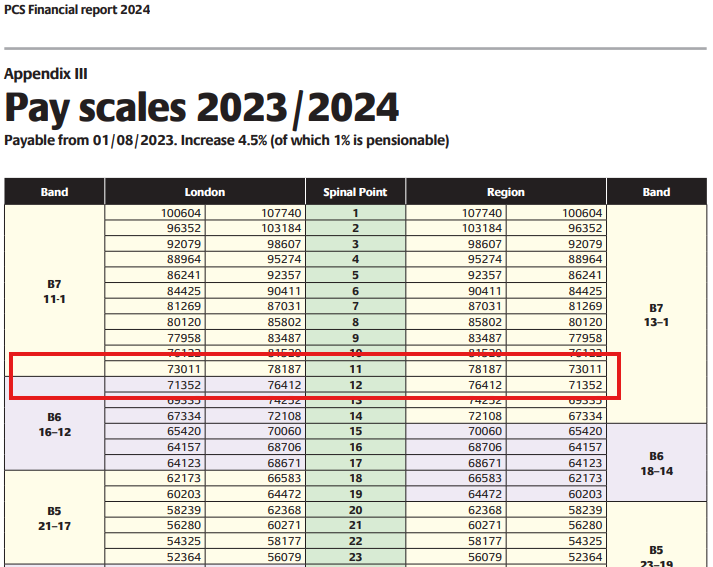
Below are the top salary bands of PCS employees in 2023 from the publicly available 2024 Financial Report. The new ‘super-grade’ (B6a) sits between the top of B6 and within the B7 scale.

The successful candidates for both new positions were coincidently long-term allies of the General Secretary and supporters of Left Unity. They have seen massive pay increases.

For context, the General Secretary is the only staff member who takes home the top B7 band, as Assistant General Secretary John Moloney continues his election pledge to only take the wage of an average PCS member.

These changes represent an ongoing liability for PCS members, and a permanent increase in the balance of membership subs paid on staffing. A liability, as Table 1 below illustrates which represents an additional 55p plus a month per member than last year. And that’s in August, the number is likely to increase.

(Again, the union’s finances are a matter of public record)

The strategic decision to alter the structure of the union and expand the staffing budget was not scrutinised by the NEC as it should have been before it was introduced.

We were not prepared to endorse this rebalance of the union’s finances away from services and onto new, highly remunerated staff.

It is worth stating that the staff union, GMB were rightly consulted on the changes and accepted them. But there is a significant democratic deficit when the GMB have more of an say over how your subs are spent than the elected PCS National Executive Committee, accountable to you.

The levy

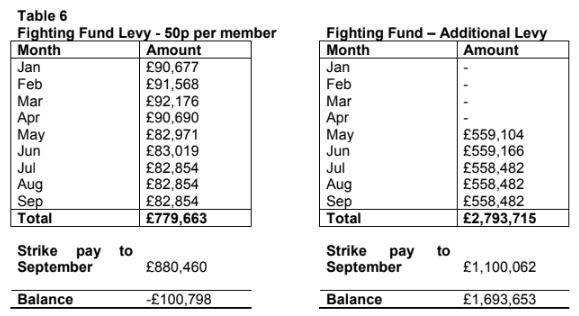
£900k has been spent from the general fighting fund to fund the courageous and escalating action of our FM members across departments. There is consequently an over £100k deficit in that account.

As you can see below, the additional levy is in the black. The only way we can continue to sustain funding for FM dispute is to borrow against this account.

With or without the levy we must find a way to fund current and future action, or we stop it.

Left Unity would simply have us cancel a sustainable source of funding completely.

We have consistently proposed reducing and reconstituting the levy. But if we want to continue to fund and grow these disputes, as the coalition does, we need to fund them.

Where do Left Unity propose to get this money? Or do they want to wind down the outsourced workers action?

Not only would Left Unity have us cancel the levy, but they also want us to fund their unnecessary and unaccountable additional staff burden with no new money.

Increase membership subs?

The unions Finance Committee, which contains a majority of Coalition for Change members, refused to recommend a members subs increase to the NEC. However, the paper presented to the NEC by the General Secretary ignored this and recommended a 5% increase from January.

There was rightfully opposition from Left Unity members at the NEC to this proposal and thankfully the General Secretary on considering the opposition agreed to withdraw the recommendations.

The question for Left Unity comrades now is, how do you want to fund the General Secretaries new staffing structure alongside the – hopefully increased – action of PCS FM workers?

We don’t accept increasing the subs you pay to the union to fund these unnecessary new, super-paid members of union staff.

Keep the Levy vs increases unions subs

The levy and the remainder of the budget of the union, paid for by the bulk of your subs are separate things.

The levy is earmarked for supporting industrial action, members know where that money is going. The rest of the budget is around agreeing a set of spending priorities which are often strategic and political.

As mentioned, the majority of the NEC doesn’t agree the spending priorities of the General Secretary, which have been imposed unilaterally, without scrutiny.

It’s our responsibility as the custodians of the unions finances to continue to argue this point.

‘Tory austerity’?

Left Unity claim that refusing to endorse their budget is akin to ‘Tory Austerity’.

To be absolutely clear, the union is not the same as the Government. The union cannot print money, sell bonds or raise taxes on the rich. Nor is it a profit-making corporation.

PCS is a membership organisation, funded entirely by the subs of its members, many of whom are on the minimum wage.

We don’t believe that such insults or comparisons are correct or helpful. However, as they have now been levelled at us, we offer a more accurate analogy.

Members will remember the government using the pandemic as an excuse to agree wasteful contracts, furnishing their allies in the business world with £m contracts for worthless PPE without any parliamentary scrutiny.

We refuse to allow such unaccountable mismanagement to occur in PCS.

It is, of course also true that Left Unity have consistently voted for cuts in budgets and staff. When the union had to tighten budgets and cut staff when the impacts of check-off hit, did comrades cry ‘austerity’ or claim the budgets read like an employer paper or as claimed a Tory budget. Of course not.

Too honest’

IL supporters made these points in contributions to the debate at the NEC on the 7th. We were criticised in the General Secretaries right of reply and in subsequent Left Unity articles for being ‘too honest’.

The NEC will will revisit the question of the budget at December’s meeting, but no member should expect that NEC members should roll-over and accept unilaterally imposed financial pressures on creating an even greater layer of staff to the detriment of members services.

We will make no apologies for doing so and will continue to be open, transparent and ‘too honest’ about the situation.