The fact that civil servants are badly paid is basically axiomatic at this point. The report PCS commissioned Dr Mark Williams to produce on our pay confirmed this categorically.
But what is talked about less is just how much variation there is in how badly civil servants are paid. In-grade pay disparities within the civil service are a systemic and damaging injustice.
Mind the gaps
The Institute for Government’s (IfG) reported that civil service pay in each grade has fallen in real terms by between 12 and 26 percent since 2010 (‘Whitehall Monitor’, 16/01/2024). Pay disparities between different departments are striking. An IfG report (February 2023) showed that median AO/AA pay at MoD was £20,423, over £4,000 less than the median AO/AA salary in the Welsh Government. Pay at DCMS at every grade between AO/AA and SCS consistently lags median civil service pay by thousands of pounds.
The 2023 pay rise and limited sectoral/employer deals do little to unpick these disparities. Within departments, bargaining units, and workplaces, there are huge disparities in individual pay at the same grade and even in the same role.
Gender and disability pay gaps remain, too. Men were, on average, paid 9.1% more than women in 2023, according to Dr Williams’ report. This has shrunk since the mid-2000s but is still inexcusable. Even more worrying is the disability pay gap – 8.4%, and widening.
Aims without plans
Given all this, it is a positive that the PCS 2024/25 pay demands include ‘pay equality across departments on the best possible terms’. This, the current leadership tell us will provide ‘pay coherence’ via an end to delegated negotiations and a return to national pay bargaining, ‘a longstanding aim of PCS’.
There’s an aphorism in one of author and poet Antoine de Saint Exupery’s books that says our ‘task is not to foresee the future, but to enable it’. The leadership may say national pay bargaining is a longstanding aim, and indeed Left Unity members will occasionally mention it in a speech, but evidence of them actually doing anything to enable this aim is scarcer.
While it is progress that our pay claims are no longer a demand with a flat percentile increase and little detail, it is unlikely that making ‘demands’ over departmental pay equalities in pay claims will do much. The government will point at the 1995 Civil Service (transfer of functions) Order and case law to say that departments are separate employers, and so divergence, and local negotiations, are only natural. Dealing with inequality is something we will have to force either on the picket lines or in the court room.
The Law
How does the government legally justify the disaparites in our pay for work of equal value / grading given that all civil servants work for the same employer – the Crown? Salaries, Ts&Cs, and bargaining were delegated from the centre to departments by an Order in Council in 1995 – the employer uses this state of affairs to prove that civil servants in different departments in fact work for different employers.
In 2005, this approach was upheld in the Court of Appeal in Robertson & Others v DEFRA, a case in which the PCS supported male AOs and EOs at DEFRA making an equal pay claim on the basis that women at DETR earned more for work of equal value. They brought the claim not under the Equal Pay Act, but Article 141 of the European Community Treaty, which placed a duty on states to enforce equal pay not just within an establishment, but across an entire employer – the ‘single source’ of employees pay inequalities, and the authority capable of remedying it.
However, the presiding judge, John Mummery, ruled that while the ‘general proposition’ that the Crown was the ‘single source’ of civil servants pay, terms and conditions had ‘considerable force’ (paragraph 31), he ultimately found that because of delegated negotiations, ‘neither the Treasury nor the Cabinet Office is involved in the negotiations and their approval of settlements is not required. There is no co-ordination between the different sets of negotiations’ and so the Crown was therefore not the single source (paragraph 35).
No similar test case has been brought since. But a lot has changed in 20 years – bar a sectoral/flexibility deal (approved by Treasury), and some limited tinkering around how a headline percentage increase is distributed, civil service pay remits and set in stone by the centre, as any local negotiator will know. Terms and conditions are also delegated, but dictats from the centre like the 60% attendance policy show that this departmental independence is a fiction that can be done away with if need be.
In 2013 a Supreme Court judgement noted that the EHRC believed that Robertson was wrongly decided, ‘because it did lie within the power of the Crown to put matters right’ – there is a need to support branches via legal services to allow challenges on this and less novel disparities within departments and establishments. One victory could benefit every member.
Industrial options
Trade unionists and socialists would be wise to not have any illusions who the law is made for, though. As Marx and Engels remarked, it is just another tool through which the ‘ruling class assert their common interests’. Industrial power remains our greatest weapon.
Given the sheer scale of inequalities between and within departments, it remains unfathomable that the leadership has not sought to mobilise groups, departments, regions, and branches in the union to take industrial action against pay inequalities. GMB is currently pursuing such a course with the members it represents in ASDA (where shop workers are paid £3 less an hour than those in distribution centres), and with care workers employed by different Scottish councils (where the Scottish government is the ultimate arbiter of their pay). Both these campaigns are generating significant publicity, engaging members in action (including winning strike ballots) and exerting significant industrial pressure on the employers. Why isn’t PCS agitating for similar disputes in the civil service?
IL’s motion, legal services and pay policy provide a way – vote for us
One of the more memorable slogans of the Paris revolutionaries in May 1968 was, “be realistic, demand the impossible!” The current PCS leadership has seemingly heeded the second part of this advice in their recent pay claim but decided to ignore the concurrent requirement for realism. Expressing a desire for pay coherence means nothing without a coherent plan of how it will be achieved.
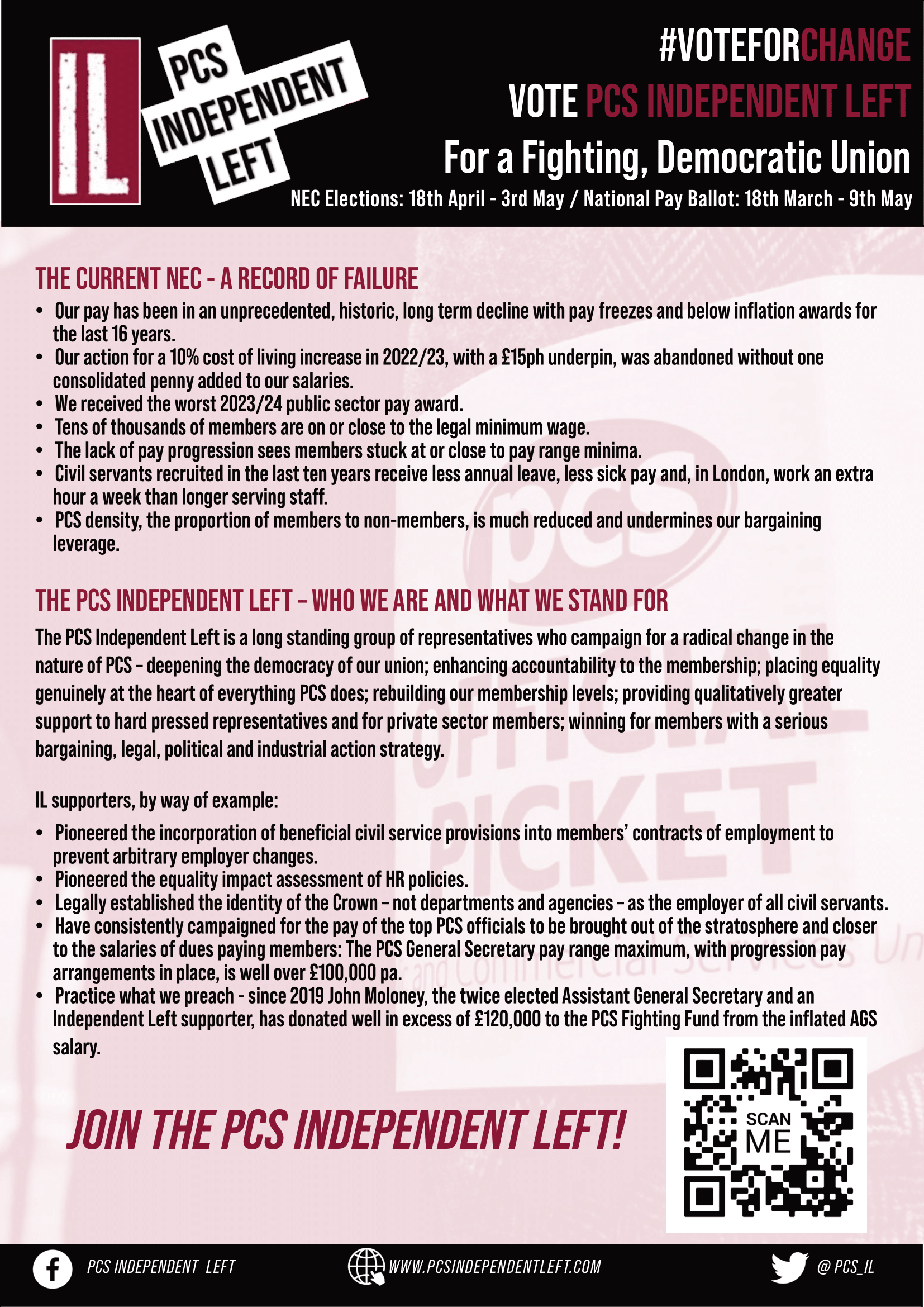
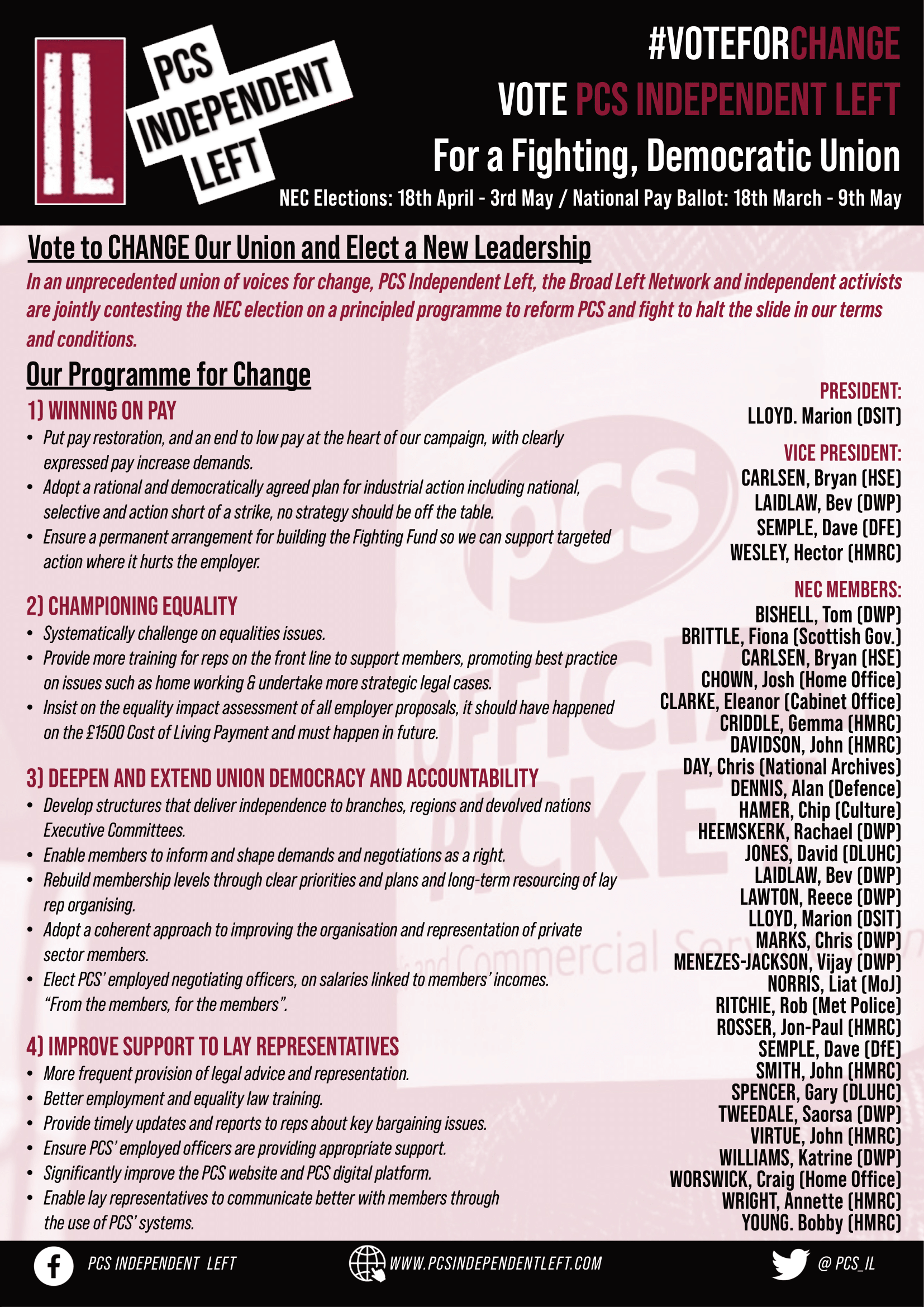
IL candidates are standing for NEC elections this year as part of a coalition for change in PCS including the BLN and other independent groups. We have a manifesto and strategy that will begin to create the conditions, industrial and legal, in which PCS can fight pay disparities.
Our platform is committed to assisting and empowering reps to pursue disputes and cases over discrimination and inequalities, to build pay claims which seek to address the detrimental pay, terms, and conditions on which newer members of staff have been recruited. To support such claims, we will strengthen and open up PCS’ legal services, also a key priority of the recently re-elected, IL backed, assistant general secretary, John Moloney.
To help fulfil these ambitions, IL members have submitted motion A4 to this year’s conference. It instructs the the NEC to collect and make available granular data on pay inequalities, empower to reps to agitate, mobilise, and rise disputes industrial and legal.
But all the motions in the world will be insufficient if we continue to have a leadership set on repeating the same failed industrial strategy again and again. We need a new, radical leadership. The IL/BLN slate offers just that.


 PCS Independent Left