At New Year it is customary to look forward to the year ahead.
Unfortunately when we do, the outlook seems grim.
For the UK Civil Service, it is likely that the upcoming pay remit will be a mere 2.8% (this is what the Government is recommending to the pay review bodies, and we unlikely to do better than that). Almost certainly job losses will happen, with the FT reporting that 10,000 posts will be lost, and we think this figure could be higher as departments are under instructions to achieve ‘efficiency gains’ and are undergoing a spending review that is designed to lead to further cuts.
All this has to be seen against the background of the long-term decline of the real value of Civil Service pay, with awards year on year below the rate of inflation. The result of this is that between 2010 and 2023, median Civil Service annual pay fell between 15% and 38%, depending on the grade and inflation indicator. And, unlike Left Unity, we don’t forget that the UK Civil Service got the worst awards in the whole public sector in 2023 and 2024.
Whilst the position in the devolved Scottish and Welsh Civil Service, or in the Met, won’t be so bad they will still face budget pressures which will lead to low pay remits and restrictions on staffing. Certainly our members in the private sector will feel those budget pressures as well.
So what should we do?
Any union worthy of that name would be preparing to fight but unfortunately despite the rhetoric, Left Unity have no intention of doing anything but go through the motions of pretending to resist.
Therefore one of the key tasks has to be winning a clean sweep in the 2025 NEC elections, removing the deliberate obstruction to change, and frankly, electorally getting rid of LU.
The NEC on 7/11/24 started with the President ruling the NEC Majority’s motion on the national campaign out of order. The decision was challenged, but a two-thirds majority was not reached. Results were 14 for, 16 against.
The General Secretary committed to getting a full picture of the position of groups’ delegated pay talks for the December NEC. IL hope this will enable a full and open discussion on the National Campaign. She believes the vast majority are utilising the 5% remit from the Treasury.
Motion 7 referenced reducing the levy but as above mentioned this was ruled out of order.
The General Secretary’s paper on the national campaign made no proposal on the levy, due to Standing Orders prohibiting revisiting decisions within three months.
There was no specific motion on the levy but the President took a vote on whether the NEC was willing to revisit the previous NEC decision to not pause the levy. IL and the other NEC Majority members voted against this because we want an open and informed discussion and decision on the levy with the option to review and reduce, the result was 15/15 (two thirds majority required). We hope to be able to discuss this in more detail at the December NEC.
IL believes that levy should be significantly reduced, but again, there was no option for IL members to vote for this. In addition, IL believes that PCS needs to ensure that money is raised for disputes outside of the national campaign, especially those in facilities management, including members in G4S.
The General Secretary reported that PCS is pushing for improvements to Employment Right Bill. PCS is also making the case that the civil service should not wait for the bill to look making improvements to terms and conditions, such as removing restrictions on facility time.
PCS NEC Majority comrades moved a motion to add “flesh on the bones” to PCS’s position on the Employment Rights Bill, confirming areas where the bill is lacking and giving actions to campaign for improvements. This motion was carried unanimously.
Agreement was also reached on papers regarding Organising, the PCS Parliamentary Group, TUC Women’s Conference motions and TUC Youth Conference motions among other items.
The General Secretary introduced a paper ‘for noting’ regarding the role of NEC Liaison Officers (NECLO) to Group, Forums and Regions, apparently aimed at clarifying the role. The General Secretary believes that NECLOs should report NEC meetings and positions neutrally, taking collective responsibility for the decisions of the NEC, without concentrating on the positions of different groups participating in those discussions. This directive to NECLOs came despite the General Secretary’s own recent communication to all members, using PCS-held members’ emails official social media accounts, that gave a biased and inaccurate report on NEC business.
This demonstrates the General Secretary’s double standard on taking collective responsibility for NEC decisions. The NEC Majority refused to note the paper. However, due to numbers present at the time, the vote was 16-16, and the President had the casting vote to note the paper.
In a break from normal procedures, in which the lay-led Finance Committee’s report is put to the NEC by the Assistant General Secretary, the General Secretary decided to move an alternative Finance report containing the recommendations of unelected full-time officials in the Finance Department.
These recommendations, which had been rejected by the Finance Committee, were shared with NEC members in a 17-page paper one hour before the NEC meeting commenced. This is unacceptable and undermines elected NEC members’ ability to properly scrutinise the union’s finances.
Having been prevented from voting on the Finance Committee’s own recommendations, the NEC discussed the General Secretary’s Finance Report, which among other recommendations proposed an increase to members’ subscriptions of 5%.
IL believes that the elected Finance Committee should be given the opportunity to scrutinise any proposed increase to members’ subscriptions, to ensure that such a move would be necessary and proportionate, and that members’ subs are being used in the best way. We also maintain that the Finance Report should be proposed by the elected National Treasurer, a role held by Assistant General Secretary John Moloney.
During the NEC debate, the Democracy Alliance (the NEC minority, who count the General Secretary and President among their members) sought to argue that rejecting the 5% subscription hike would prevent PCS from raising wages for its full time officers by the same proportion, which would only be true if members’ subscriptions were entirely spent on staff costs. In reality PCS’ financial picture is more complex than that, collective bargaining with GMB (the union for PCS staff) should determine the agreement on full-time officer pay, and Conference has in any case decided to reiterate PCS’ commitment to limiting staffing costs to 33% of subscription income. After a lengthy discussion, it was decided to make no decision, and the Finance Committee will be reconvened.
There were various items on the NEC agenda which did not get heard due to the lengthy debates on Finance, NECLO responsibilities and the National Campaign. These items include the majority of motions submitted by NEC members, Artificial Intelligence, Facilities Management, ARMs, H&S and Climate Change.
*7/11/24 was one day meeting, December NEC scheduled to be two day meeting.
Members elect the NEC to carry the responsibility for scrutinising the budget of the union and how your subs are spent.
At the NEC on the 7th of November, at hours’ notice, the meeting was asked to endorse a set of budgetary parameters.
In short, the NEC majority was not prepared to endorse a set of budgetary parameters, presented to the NEC on the day of the meeting, which ignored the recommendations of the unions finance committee and which coupled with a potential pause of the levy, created a blackhole for the fighting fund, rebalanced money away from services towards an unscrutinised staffing re-structure and demanded an additional 5% in membership subscriptions from members to pay for it.
Following the meeting the Left Unity minority on the NEC posted a series of denunciations online of those NEC members opposed to these parameters.
As it happened the General Secretary, following opposition to some or all of the parameters from members across the political divide, withdrew them. So, for all the bluster, the NEC reached unanimous agreement on the way forward.
However, if this hadn’t happened the NEC majority had called for them to be remitted. We would like to offer to reps and members, with evidence and context, our rationale for doing so.
Members and reps deserve to know what your subs are being used for.
The uniliteral imposition of a new staffing structure
The NEC on the 7th of November was the earliest opportunity we’ve had a finance paper which reflects the financial impact of this decision and the consequential balance of members money being spent on it.
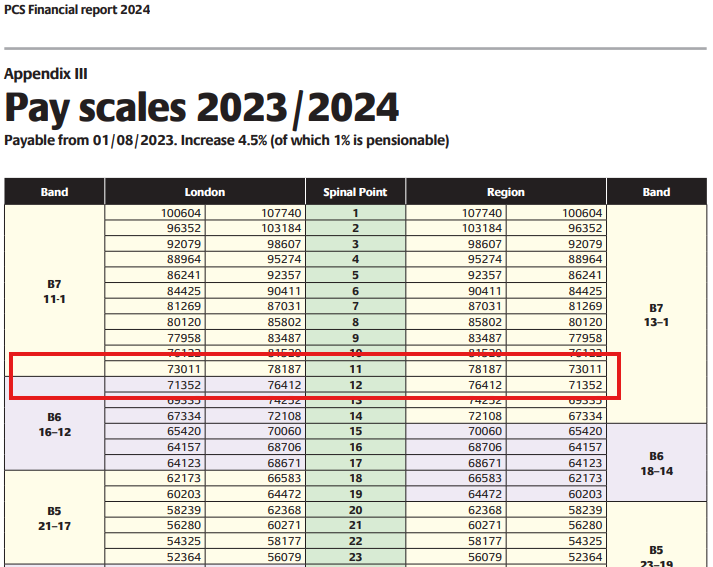
Below are the top salary bands of PCS employees in 2023 from the publicly available 2024 Financial Report. The new ‘super-grade’ (B6a) sits between the top of B6 and within the B7 scale.
The successful candidates for both new positions were coincidently long-term allies of the General Secretary and supporters of Left Unity. They have seen massive pay increases.
These changes represent an ongoing liability for PCS members, and a permanent increase in the balance of membership subs paid on staffing. A liability, as Table 1 below illustrates which represents an additional 55p plus a month per member than last year. And that’s in August, the number is likely to increase.
(Again, the union’s finances are a matter of public record)
The strategic decision to alter the structure of the union and expand the staffing budget was not scrutinised by the NEC as it should have been before it was introduced.
We were not prepared to endorse this rebalance of the union’s finances away from services and onto new, highly remunerated staff.
It is worth stating that the staff union, GMB were rightly consulted on the changes and accepted them. But there is a significant democratic deficit when the GMB have more of an say over how your subs are spent than the elected PCS National Executive Committee, accountable to you.
The levy
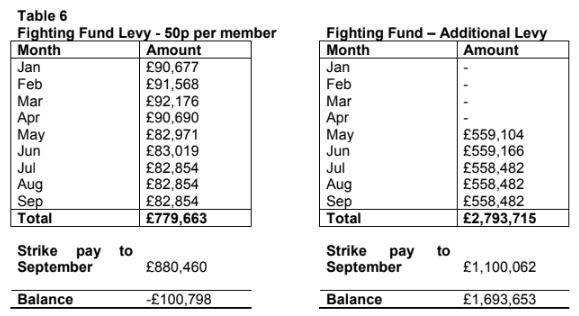
£900k has been spent from the general fighting fund to fund the courageous and escalating action of our FM members across departments. There is consequently an over £100k deficit in that account.
As you can see below, the additional levy is in the black. The only way we can continue to sustain funding for FM dispute is to borrow against this account.
With or without the levy we must find a way to fund current and future action, or we stop it.
Left Unity would simply have us cancel a sustainable source of funding completely.
We have consistently proposed reducing and reconstituting the levy. But if we want to continue to fund and grow these disputes, as the coalition does, we need to fund them.
Where do Left Unity propose to get this money? Or do they want to wind down the outsourced workers action?
Not only would Left Unity have us cancel the levy, but they also want us to fund their unnecessary and unaccountable additional staff burden with no new money.
Increase membership subs?
The unions Finance Committee, which contains a majority of Coalition for Change members, refused to recommend a members subs increase to the NEC. However, the paper presented to the NEC by the General Secretary ignored this and recommended a 5% increase from January.
There was rightfully opposition from Left Unity members at the NEC to this proposal and thankfully the General Secretary on considering the opposition agreed to withdraw the recommendations.
The question for Left Unity comrades now is, how do you want to fund the General Secretaries new staffing structure alongside the – hopefully increased – action of PCS FM workers?
We don’t accept increasing the subs you pay to the union to fund these unnecessary new, super-paid members of union staff.
Keep the Levy vs increases unions subs
The levy and the remainder of the budget of the union, paid for by the bulk of your subs are separate things.
The levy is earmarked for supporting industrial action, members know where that money is going. The rest of the budget is around agreeing a set of spending priorities which are often strategic and political.
As mentioned, the majority of the NEC doesn’t agree the spending priorities of the General Secretary, which have been imposed unilaterally, without scrutiny.
It’s our responsibility as the custodians of the unions finances to continue to argue this point.
‘Tory austerity’?
Left Unity claim that refusing to endorse their budget is akin to ‘Tory Austerity’.
To be absolutely clear, the union is not the same as the Government. The union cannot print money, sell bonds or raise taxes on the rich. Nor is it a profit-making corporation.
PCS is a membership organisation, funded entirely by the subs of its members, many of whom are on the minimum wage.
We don’t believe that such insults or comparisons are correct or helpful. However, as they have now been levelled at us, we offer a more accurate analogy.
Members will remember the government using the pandemic as an excuse to agree wasteful contracts, furnishing their allies in the business world with £m contracts for worthless PPE without any parliamentary scrutiny.
We refuse to allow such unaccountable mismanagement to occur in PCS.
It is, of course also true that Left Unity have consistently voted for cuts in budgets and staff. When the union had to tighten budgets and cut staff when the impacts of check-off hit, did comrades cry ‘austerity’ or claim the budgets read like an employer paper or as claimed a Tory budget. Of course not.
‘Too honest’
IL supporters made these points in contributions to the debate at the NEC on the 7th. We were criticised in the General Secretaries right of reply and in subsequent Left Unity articles for being ‘too honest’.
The NEC will will revisit the question of the budget at December’s meeting, but no member should expect that NEC members should roll-over and accept unilaterally imposed financial pressures on creating an even greater layer of staff to the detriment of members services.
We will make no apologies for doing so and will continue to be open, transparent and ‘too honest’ about the situation.
Outsourced staff working across government have been taking part in strike action in a dispute over pay, sick pay and annual leave.
Members at the Foregin Office, Cabinet Office, Department for Business & Trade and the Department for Science, Innovation & Skills have joined DWP G4S staff in dispute over pay. Adding in-sourcing and sick pay to their demands.
These strikes, which have seen lively and well-attended pickets, are taking place alongside the longer pay dispute waged by G4S guards working in the DWP. PCS has recruited substantially from that campaign, especially since GMB packed in their action in exchange of a derisory pay rise that leaves guards’ pay only 32p over the minimum wage.
All these disputes are incredibly important for our union, for all kinds of reasons.
Firstly, it is crucial that our movement takes on the task of fighting for workers who are paid awful wages in exchange for difficult and often dangerous work.
Secondly, it makes no sense that there should be a division in civil service buildings between in-house staff on civil service pay and conditions, and out-sourced staff working on much worse terms for private contractors. Those staff should be brought back in-house, with the levelling up of terms and conditions that would involve.
Finally, we will all be in a stronger position if guards, cleaners and other outsourced staff are organised into our union. The potential industrial power that these workers have is substantial. Without enough security guards, civil service buildings can be forced to close, and in many places during these disputes this has been happening. The leverage that these workers can help our union bring to bear on the employer is obvious.
PCS Independent Left has been pushing the need for the union to take this seriously for some time. In London, IL reps were organising meetings and pushing for action over G4S pay over a year before the current dispute in DWP began. However, Group leadership had been reluctant to ballot guards. Multiple approaches to the National Dispute Committee were made, but nothing came of it.
In the end, it was GMB organising their own dispute that shifted the Group leadership into action. If calls from their own members hadn’t spurred them into action, the fear of losing members to another union did the trick.
It shouldn’t have taken so long to push the union into action for these workers. But now the campaigns are up and running, it’s important they are well supported to win. That includes by financially backing out-sourced staff with strike pay for as long as necessary.
Before winning its landslide victory, the Labour Party declared it would carry out ‘the biggest wave of insourcing of public services in a generation’. Now they’re in power, we need to hold them to their commitments.
Left Unity (LU) – the dominant grouping within PCS for the last 20 years – has moved to the right, not only in terms of further bureaucratising the union but also in attacking reps, activists and democratic norms.
Jobs for the boys, on your dime
The General Secretary, without seeking permission from the NEC, reorganised Full Time Officer (FTO) structures. She created more senior management positions at the cost of at least an extra £169K a year, all from your subs. The aim of this new bureaucracy being to insulate them against the non-LU NEC majority. It also created senior positions for the failed candidates in the last 2 AGS elections.
An additional bulwark against democracy is the National President. Acting as an LU partisan, he has misused his powers to rule out of order most motions put forward by the NEC majority. He has paralysed PCS as a result.
Not that LU are worried, because they actually don’t want to do anything, a prime example being the 5% pay remit figure for the UK civil service.
The minority continue to block a campaign on pay
In response to the remit, the NEC majority put forward a motion saying that the 5% was not enough and that we should go back to Ministers asking for more.
Predictably, the President ruled that motion out of order, which meant that the union has not challenged the national remit figure. When the majority challenged the President’s ruling (which requires 2/3rds of NEC members to overturn), all the LU NEC members voted against overturning the ruling. That means they were against challenging the 5% remit figure.
If it is argued that they found other parts of the motion objectionable, why not move amendments to take those out? In any case, why didn’t the General Secretary in the paper to the NEC, just say we reject the 5% and we will ask for more?
She didn’t and the LU don’t, as they are content with the 5%, following as it does off last’s years pay ‘victory’ (as least according to LU).
Hypocrisy in DWP
So we see the deep hypocrisy whereby LU in DWP (who control the unions DWP Group Executive Committee) denounce the pay offer there, saying 5% is not enough, yet on the NEC didn’t challenge the remit!
Put control and power back in the hands of members
To break the deadlock we are in, the NEC majority is urging branches to ask for a Special Delegate Conference (SDC). The aim of the SDC is to pass motions which allow the NEC majority to actually make policy and to restrict the General Secretary to only using such powers as allowed by the constitution.
In response, in the last few days, a joint Branch Bulletin from the GS and President has been issued to branches telling them the ‘true facts’ of what is happening, which is nothing more than LU propaganda. Along with the bulletin, members have been emailed with the ‘truth’ (Pravda), as defined by LU, and members in branches that have passed SDC motions have also been emailed querying the legitimacy of their branches SDC motion.
This shows that LU are panicking but also that they now will use the union machinery to campaign for LU in next year’s NEC election.
We will continue to tell members that their money is being misspent, that LU’s actions mean that the union cannot respond to imposition of pay but also to the staff cuts soon to be announced in the Autumn statement.
Even if an SDC is stopped, we still have our annual conference next year where hopefully there will be a day of reckoning, most importantly LU have to be decisively defeated in the NEC elections, in particular we have to win the President’s position.
In an unprecedented move, the General Secretary and President have today by-passed branch committees to email all members in branches that have passed motions calling for a special delegate conference.
The leaders of the minority faction on the NEC are now openly utilising the unions machinery, paid by members subs, to wage an internal political war against members who seek a different direction in terms of union strategy and priorities.
In response today, many branch committees have rightfully written to their members countering the inaccuracies sent unsolicited to members’ personal email addresses.
We will write more direct responses soon. In the meantime, below is an example of the responses lay reps, who do not have the wealth of the union machinery and full-time officers behind them, have provided to their members today. We encourage reps to use this to respond to their members if they feel it useful.
Dear Member,
You will have received an email to your personal email address today from the President and General Secretary of the union titled, ‘CALL FOR A SPECIAL DELEGATE CONFERENCE BY YOUR BRANCH – THE FACTS’ (not our caps) asking you to mistrust your reps.
Unfortunately, they have made the decision to go over the heads of your locally elected reps and use the unions communications infrastructure, paid by your subs, to wage an internal political war against members who seek a different direction in terms of union strategy and priorities.
Whilst we would rather spend our time as reps, representing and supporting you as members, unfortunately as the email was sent to all of you without right of reply and contained some significant inaccuracies, we only felt it right to respond.
Our branch did pass a motion (attached) at a branch meeting in September. This was done following many other branches of our union across other employer groups and regions passing similar motions.
We passed the motion because we have 3 main concerns which we set out below. The email sent to members claims to refute the facts of the motion. We’d like to briefly set-out why it doesn’t:
1) Pay: The General Secretary and President are content with not challenging the 5% cabinet office pay remit – once again the worse pay offer in the public sector and one which comes with strings attached – job cuts.
Proposals to change this position have the support of the majority of the NEC which you elected last year. Proposals to reject the remit, request negotiations are broadened out to include pay progression, flexible working etc and to begin a national campaign to achieve such objectives have been ruled-out-of-order by the National President.
This much is admitted in the email you will have received. We don’t accept these proposals ‘contravene the rules of the union’ and are happy to supply them to members on request.
2) More union staff on much higher salaries: The General Secretary has made the executive decision, without NEC oversight, to create a new super-grade in the union and more senior roles.
The successful candidates for the 2 new super-grade vacancies are coincidentally current, or recent members of the General Secretaries grouping in the union. These 2 individuals were also, again coincidently, the 2 failed candidates from the last 2 elections for Assistant General Secretary.
The additional vacancies below the new super grade also went to current or recent members of the General Secretary and President’s group in the union.
Disregarding the political connections for the moment. Increasing the number and salaries of paid employees of the union, who’s salaries are paid for by members subscriptions constitutes ‘major financial changes’ and liabilities in any language. And represents a much larger percentage of members subs – including many on the poverty line – spent on staff rather than waging effective campaigns to improve the interests of our members.
All of this done without the consent of the elected NEC or the elected National Treasurer, the Assistant General Secretary.
3) Union Democracy: With no way forward on either question, the only way the deadlock can be broken is for the union to hold an extraordinary conference – conducted online to save the £250k quoted in the email – to put the power and control of the union back in the hands of members and local reps.
Even if you were to accept the arguments in the email, that is surely something everyone who believes in a member led union can support.
Lastly, the email refers to ‘certain organisations operating in the union’. We can assure you that the only organisation which discussed and passed the motion on your behalf was the Branch Executive – elected by you every year. And we did so with the interests of members at the forefront of our minds.
We sincerely hope that this doesn’t dissuade you from continued union membership. This doesn’t change the dedication of reps on the ground to ensure you are represented and supported.



 PCS Independent Left