Proven: A fundamental failure of the union leaderships’ equality duties

On the 14 July, the General Secretary issued a briefing to bargaining units. Attached to that is an exchange of letters between the General Secretary and the Cabinet Office Minister Jeremy Quin.

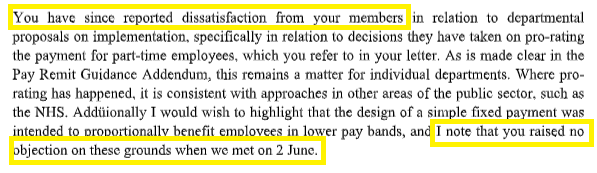
In response to Mark Serwotka’s arguments around the pro-rating of the £1500, the Minister replied (all emphasis is ours):  

You have since reported dissatisfaction from your members in relation to departmental proposals on implementation, specifically in relation to decisions they have taken on pro-rating the payment for part-time employees, which you refer to in your letter. As is made clear in the Pay Remit Guidance Addendum, this remains a matter for individual departments. Where pro-rating has happened, it is consistent with approaches in other areas of the public sector, such as the NHS. Additionally I would wish to highlight that the design of a simple fixed payment was intended to proportionally benefit employees in lower pay bands, and I note that you raised no objection on these grounds when we met on 2 June.

Extract from the 4th June letter from Jeremy Quin MP to Mark Serwotka

There you have it from the horse’s mouth, on the 2 June the GS did not object to the pro-rating of the bonus. That this was not considered a problem is confirmed by the membership videos, email briefings, and website reports that followed the 2 June announcement on pay by the Minister. In none of those are problems with the pro-rating mentioned.

Indeed, in guidance to pay negotiators they were told to, “seek a clear, up-front commitment to the payment of the £1,500 lump sum for all staff (pro rata where applicable). We still haven’t received a response as to when the union thinks it would be applicable!!

Only after pressure from activists and members did Mark Serwotka send a letter to the Minister objecting to pro-rata payment, but 28 days after the minister first told the leadership about the instruction or discretion give to employers to pay on that basis, and only following considerable membership anger.

As we said in an earlier posting ‘That is not “campaigning,” it is evidence of fundamental failure in the leadership’s exercise of its elementary equality duties as negotiators’.

Don’t Mourn, Get Organised, Vote NO

The Union is hoping to end the campaign through getting a Yes vote in the ballot that starts in August.

We are urging members to vote against:

  • The NEC in its pseudo ballot consultation by returning a resounding ‘NO’ to their strategy to end the dispute.
  • The leadership’s candidates for General Secretary (Fran Heathcote) and Assistant General Secretary (Paul O’Connor) later this year.
  • Vote to remove the NEC majority in next year’s NEC elections.

Branches are being organised through the Branches Say No campaign. Go to its website and discuss in your branch the statement, contact the campaign to say you will support it, and make use of the materials to agitate for a reject vote. Also follow the PCS Say No twitter account.

And don’t forget, even if the dispute continues the monies will be paid. There is no offer for us to accept or reject, what the union is balloting on is whether we end or continue the dispute.

VOTE NO

The lowest pay-rise in the public sector

No sooner had the NEC announced it was ending all national action to improve the 4.5% pay offer, the government announced it was accepting all recommendations from public sector pay review bodies, giving all other public sector workers a better pay rise.

Of particular note is that workers in sectors who haven’t given indications of giving up the fight – healthcare and education, are being given more pay.

Education workers, for example are to receive a 6.5% consolidated pay-rise, a settlement their leadership is putting to the membership – although not without considerable opposition from those members who believe they can fight and win more.

Closer to home, Senior Civil Servants are being given a 5.5% pay rise further increasing the pay differential between the junior and senior civil service and providing a proper kick in the teeth for the majority of civil servants who deliver on the ground.

If the concessions weren’t enough already (they weren’t) they certainly aren’t now.

From Militant Action to Humble Petition

Clearly caught off-guard, having previously lauded the 4.5% as ‘a considerable concession’, the union leadership was bounced into reacting to the new situation; that they were, for all intents and purposes, ending the national dispute having only secured the lowest pay settlement in the public sector.

The logical response would be to admit the decision to suspend our leverage by pausing re-ballots and industrial action on the basis of 4.5% was wrong, and commit to further action to achieve minimally the average 6.5% being offered to the rest of the public sector.

Instead, the union doubled down on its previous decision to suspend action, stating that it would ‘enter into negotiations with individual employers’ and ‘demand at least the same pay increases as other public sector workers’.

It doesn’t take a skilled negotiator to identify 2 outstanding problems with this strategy:

  1. The remit from the cabinet office is 4.5% of the pay-bill. While employers can choose how to allocate that money among employees, 4.5% is still the totality of the pie they have to work with. Even with the additional 0.5% wriggle-room for the lower paid, they cannot provide a 6.5% increase for all workers even if they wanted to.
  2. Regardless of 1, what leverage do negotiators have to achieve this? The employers are aware that the union has suspended all re-ballots and is allowing all current ballots to expire with no new action taking place.

We are aware that some on the NEC have claimed that negotiators, presumably by some act of alchemy, could achieve pay-rises above 4.5% for most members within the current remit.

While it’s possible in smaller, policy centred departments with fewer junior members of staff, to gear the money towards the lower paid, this cannot happen in in large operational departments.

In DWP or HMRC, where most of our members work and where more than half the collective 130k+ employees are AA-EO, it would be mathematically impossible to target a meaningful higher percentage of an already tiny pay-rise at the lowest paid.

The maximum increase to the pay-bill is still 4.5% and will be without further action. Unless of course the National Minimum Wage increases and departments are forced into increasing pay, not through union action, but through their legal obligation.

What next?

As long as the union is in a period of ‘pause’ while balloting on the NEC’s ‘strategy’, the longer we are inert and unable to exert any pressure on the government to improve the pay settlement. Contrary to the NEC’s position, we now have no leverage by which to secure the same pay-rises as the rest of the public sector.

We believe branches should continue to raise these issues with members and commit to campaign for a reject vote in the upcoming ballot.

Branches should follow the PCS Say No twitter account and discuss the statement on the PCSSayNo website, pass it and make use of the materials to agitate for a reject vote.

Slightly longer-term, members, reps and branches should consider whether they want to support candidates in the upcoming General Secretary and Assistant General Secretary election who support the current dire position or those who have consistently argued for a continuation and escalation of the dispute.

John Moloney, a supporter of the Independent Left is the incumbent Assistant General Secretary and is standing for re-election. John is the only Senior Full-time Officer of the union, indeed the only member of the National Disputes Committee, who has consistently argued for the continuation of the dispute and against settling on the current concessions. We urge support for his re-election.

PCS leadership vote to kill national campaign

Yesterday, the Mark Serwotka/Fran Heathcote/PCS Left Unity leadership voted to kill our campaign for a 2022/23 10% cost of living pay rise and a £15ph National Living Wage (NLW), having won the worst pay offer in the public sector.

In a nutshell, the NEC:

  • Is misleading you over the membership feedback it has received.
  • Is overstating the progress made against our claims.
  • Has given up on the fight for the 2022/23 consolidated 10% cost of living pay demand.
  • Has given up on the 2022/23 £15/hr minimum demand, to lift tens of thousands of members out of low pay.
  • Has decided to accept that nearly all members will receive yet another below inflation pay award in 2023/24
  • Will live with the fact that nearly all civil service employers will pay the one off, non-pensionable lump, sum of £1,500 on a pro-rata basis, not drawing one lesson from the failure of national negotiators to meet their elementary equality duties on behalf of our members.
  • Will ask members working for employers that have refused to pay the lump sum to either accept their lot or fight on alone.
  • Accepts that non of the payments are funded by new money, with money coming from frontline services and potential job losses and redundancies.
  • Will enter talks on job security and pay coherence without any industrial pressure being applied to the Government.
  • Is supposedly “pausing” (ending) our national campaign.

The rest of this article deals in detail with aspects of the NEC’s decisions and propaganda.

NEC’s consultation claims

The NEC states that it received over 160 responses from branches and based on that feedback agreed to run an online consultative ballot from 3 to 31 August.

Revealingly, the NEC made no attempt to break the consultation down for you. If that happened in a Government consultation exercise, the leadership would be rightfully angry.

We are angry. It is clear that most responses were critical of the government’s package of measures and many favoured renewing our strike action and campaign. Whatever one’s views, we are entitled to a transparent, full, and accurate report about the membership and branch feedback.

The NEC’s Orwellian claim of significant progress

The national union states in its 2 July message to members, “We have made significant progress” but adds, “Nevertheless we have clearly not won all of our demands.”

Yet, if we benchmark those claims against what we demanded and what we have received, it turns out that we have not won any of our demands.” Most importantly for most members, we have not won our demands for a 2022/23 cost of living increase and £15ph underpin for the lowest paid workers.

All we have been given is:

  • A one-off payment (welcome though that concession is) which is not being paid in full to part time staff, which is highly restrictive in coverage, is not a substitute for a cost of living rise and will actually cause financial detriment to members claiming UC and child benefit.
  • A promise of talks on job security and “pay coherence.”
  • A ‘promise’ from the government not to make further detrimental changes to redundancy terms until after the next election.

See here for fuller scoresheet of our demands vs. the concessions

NEC kills the claim for a 10% pay rise in 2022

At its meeting of 12 July, the NEC did not explicitly vote to dump the claim for 10% cost of living pay rises , but in reality it has been dumped.

The NEC knows full well that management teams will not discuss our 2022/23 national cost of living claim in 2023/24 delegated pay talks. Yet the NEC has refused to submit to the Cabinet Office (CO) a national, inflation proof, cost of living claim for all employers for 2023/24.

If the NEC are not prepared to make a cost-of-living demand for 2023/24, we can take it for granted that the cost-of-living demand for 2022/23 is dead in their eyes.

NEC abandons the claim for a National Living Wage

Tens of thousands of PCS members – after 23 years of this union leadership – remain on or near the minimum wage. Our low paid members took a terrible hit in 2022. The little respite they subsequently obtained, by way of a further increase in salary, came, sadly and dreadfully, because of the Tories increasing the minimum wage in April this year and not as a result of industrial action.

In May Mark Serwotka stated, “In HMRC alone, almost one in three staff are now on national minimum wage. In DWP one in five staff are having to claim in-work benefits. These people…are suffering the consequence of year after consecutive year of meagre pay rises leaving tens of thousands of them in financial crisis.”

Those comments remain true. Yet the NEC is not fighting for the 2022 National Living Wage claim and it has refused to submit to the Cabinet Office a NLW claim for 2023/24.

NEC abandons 2022 national pay fight, preferring divide and rule 2023 delegated talks

Earlier this year, Mark Serwotka told the Cabinet Office Minister that an offer of talks about 2023/24 pay was not enough, “that the cost-of-living crisis faced by our members and the disgraceful levels of in-work poverty that they are suffering from must be immediately addressed, and that “There will be no resolution to the current dispute without the issue of 2022/23’s pay being addressed.”

These issues have still not been addressed. Yet the 2022-23 national pay campaign has been “paused”, and we are being marched into 2023/24 delegated pay talks in well over 100 employers.

The Minister stood firm, the PCS leadership did not.

NEC salutes the 2023/24 pay remit it previously dismissed as ‘inflammatory’, ‘derisory’ and ‘insulting’

To bolster their exit strategy from the 2022/23 dispute, the NEC describes the Government’s below inflation 2023-24 civil service pay remit as a “significant concession.”  

But that is far from the line they took when Government published the remit in April:

  • Mark Serwotka said the remit would pour fuel on the flames of resentment after more than a decade of pay freezes and sub-inflationary rises.
  • In a video, he stated: “other workers have already rejected out of hand a payoff of four and a half to five percent for 2023. That is not enough, it’s half the rate of inflation and we need more.”
  • PCS supported the Early Day Motion 1097, which described the 2023/24 pay remit as “derisory”, noted that it had been set below inflation at an average of 4.5 per cent, “following an insulting… award of two per cent for 2022 to 2023”, said it would do “nothing to tackle years of endemic low pay”, and called on the Government to offer a real-terms pay rise.

Now, after waking from the nightmare version of the 2023/24 pay remit and dozing off again to a gentler dream, the NEC has discovered that the “key point” is not that the remit is “derisory”. No, the “key point” now, is that 4.5% plus 0.5% “is more than double [the Government’s] originally intended figure of 2%”.

A truly outstanding Damascene turn which must raise the eyebrows of even the least cynical observer.

Of course, that original figure of 2% was mooted in November 2022 for all the public sector; was never formally put to PCS and reported to members as such; and shifted upwards across the public sector as the Government grappled with roaring inflation and a public sector pay crisis.

NEC privately accepts below inflation awards in 2023/24

The NEC’s report to members is startlingly silent as to the pay increase it is seeking for members in 2023/24.

One might wonder how a national union leadership, supposedly leading a fight to halt cuts to the value of members salaries and to end low pay, could be silent on the question: How much should we ask for?

The NEC is silent because it:

  • Is intent on extracting the union from our current dispute with the Government.
  • Refused to submit a claim to the Cabinet Office for the coming pay year, which would establish a benchmark against which members could measure the 2023-24 pay outcomes.
  • Bundled us out of our 2022 national campaign and into the Tories’ divide and rule system of delegated bargaining, knowing that the Government’s “Civil Service Pay Remit Guidance, 2023 to 2024” only allows employers to make average pay awards up to 4.5%”, with flexibility for an additional 0.5% targeted at lower pay bands, at a time when CPI inflation stands at 8.7%, food and non-alcoholic drink inflation at 18.4%, and interest rates have soared.
  • Knows that many of us are heading for another below inflation award, and it does not intend to resist.

The NEC has decided not to resist the pro-rata of the £1,500 payment for part-time staff

The NEC reports that it will “continue to campaign” over the “strictures” on the £1500, including pro rating. This is disingenuous.

The leadership:

  • Accepted, certainly did not challenge, pro-rata payment on learning of its likelihood on the 2 June.
  • Welcomed the Government’s measures, including pro rata payment, as the Government hearing membership concerns on the 2 June.
  • Did not express concern about pro-rata payments in membership videos, email briefings, and website reports.
  • Told delegated pay negotiators in guidance to “seek a clear, up-front commitment to the payment of the £1,500 lump sum for all staff (pro rata where applicable)”, although it conveniently omitted to say when it would not be applicable in a bulletin to bargainers onthe 6th of June.
  • Has not campaigned on pro-rata payment and other strictures on payment.
  • Following pressure from members, Mark Serwotka did send a face-saving letter to the Minister objecting to pro-rata payment, but 28 days after the minister first told the leadership about the instruction or discretion give to employers to pay on that basis, and only following considerable membership anger. That is not “campaigning,” it is evidence of fundamental failure in the leadership’s exercise of its elementary equality duties as negotiators.
  • Complained, in the same letter, of other “strictures” on payment that were clearly set out in the government Addendum 28 days earlier.
  • Has not set out what campaigning actions it will now take to rectify the situation.
  • Has not threatened industrial action.
  • Has not announced any legal action.
  • Knows that the Government knows it is only “speaking up” now to save face in the wake of membership anger. The Government has refused to budge on these issues.

See here for fuller details regarding failure of equality duty.

Abandonment (“pause”) of strike action

The Government knows that the leadership wants out of the dispute, is busy selling to members the meagre Government package of measures announced on 2 June, and has called off action, ostensibly for months but, in all likelihood, permanently.

There is therefore no pressure on the Government to pay the lump sum in full to part time members; to immediately press outlier employers to pay the lump sum; to deliver in a comprehensive and meaningful way in talks on job security and pay coherence; to improve the 2023-24 remit; and to do anything about the 2022/23 imposed ‘awards’.

The leadership has disarmed us, and the Government is delighted.

Employer areas which are not paying the £1,500 or which are paying pro rata

The Union leadership has failed in significant ways in this regard:

  • The Government made it clear that all it was doing was giving employer groups the discretion on whether to pay a lump sum, to pay up to £1,500, and whether to pro-rata payment. Yet, on this basis the national leadership quickly began running down our dispute, easing the pressure on the government, failing to insist on a national decision on the three areas of discretion, and then came a predictable cropper when most employers paid pro-rata or even refused to pay.
  • It did not, as other public sector trade unions have done, insist on the Government funding the lump sum payment with new money. The lack of funding was an obvious incentive to resource starved employers to refuse to pay or to pay on a pro-rata basis.
  • It continues to fail to demand funding, with implications for job loss and service reduction.
  • They have left members in the outlier employers to fight alone, making a mockery of the principle of an injury to one is an injury to all. They have not made clear whether the fight for payment is also a fight for full payment to all staff in the relevant areas, not for pro payment.

August ballot

The ballot will not ask the straightforward question of whether PCS should terminate its job protection and pay campaign. Even though the NEC is slowly killing the campaign by inertia and will take the rest of July, all of August, and however long it takes to complete the 2023/24 pay negotiations, to continue its tactic of inertia, hoping members simply tire of or forget about the campaign. Instead, it will ask you to endorse its “strategy.”  

We advise you not to endorse the NEC’s “strategy” if you are one of the members who:

  • Works part time and for whom the leadership failed to insist, for a decisive month, on full payment of the lump sum.
  • Is on Universal Credit, and whose situation was not considered by the leadership in good time.
  • Is on or close to the minimum wage under this union leadership.
  • Is sick and tired of frozen pay or pay awards below the rate of inflation under this union leadership.
  • Is facing office closure and/or job loss.
  • Wants better pay.
  • Wants a leadership that is competent, and especially competent regarding equality.

Drowning your sorrows

If you want to drown your sorrows (we do not!), and you scrape together the money to do so out of your meagre salary, we advise you to drink responsibly. But we must point out to you that brewers have been weakening the alcoholic content of beer while increasing prices.

Hold the leadership to account

Rather than be sorrowful, we urge you to feel positive.

Remember those great ballot turnouts, those thumping majority YES votes, the record numbers of people – especially newly energised young members – on picket lines and the shift – small but a shift nonetheless – that we forced out of the Government. Better than feeling sad, feel positive, by insisting on accountability within PCS.

In doing so we urge members to vote against:

  • The NEC in its pseudo ballot consultation by returning a resounding ‘NO’ to their strategy to end the dispute.
  • The leadership’s candidates for General Secretary (Fran Heathcote) and Assistant General Secretary (Paul O’Connor) later this year.
  • Vote to remove the NEC majority in next year’s NEC elections.
Scoresheet of our demands against the government concessions

The NEC’s message claims, “We have made significant progress” but, in a seeming voice of reasonableness, adds, “Nevertheless we have clearly not won all of our demands.”

If we briefly benchmark those statements, comparing what we demanded (see here and here, for example) against what we have actually received, we note:

  1. 10% consolidated increase in pay for 2022/23 pay year:
    No. Not one penny has been added to the sub-inflation pay rises we received in 2022-23.
  2. NLW of £15ph for 2022/23:
    No. Not one penny more for the thousands of low paid members.
  3. Reduction of 2% in pension contributions backdated to 2019, as recommended by actuaries: No. Not one penny to be voluntarily repaid by the Government. The Government is forcing PCS to continue its legal challenge, paid for out of our membership dues.
  4. A guarantee of no compulsory redundancies:
    No. The Government has said what always says, it will avoid compulsory redundancies “wherever possible.” They could park an army of dismissed staff in that caveat.
  5. Increased job security:
    No. We have only been offered talks, but without a single upfront Government proposal for delivering greater job security.
  6. No cuts or further threats to redundancy rights: Some movement but the threat remains.
    The Government ministers have stated that they will refrain from any changes before 2025, which will require them to win the next election. But they are clear that they still want detrimental change.
  7. Significant reduction in the working week with no loss of pay:
    No.
  8. Pay coherence:
    No. We have been offered talks, but without a single meaningful improvement in the divide and rule system of civil service delegation.

A failure of leadership to meet its equality duty to members

From the outset, the NEC and national officials failed in their elementary duty to challenge the Government’s pro-rata approach and other restrictions on the payment of the lump sum. It is a sorry, embarrassing, saga:

On 2 June the Minister for the Cabinet Office briefed Mark Serwotka regarding the Government’s package of measures.

In a follow up to the General Secretary the same day, the Minister stated “The Government will issue an addendum to the 2023/24 Pay Remit Guidance which will enable departments…to have flexibility to make a fixed non-consolidated payment of £1,500 per full-time employee…subject to eligibility. You will be aware that departments should have regard to their policies on part time working and consider making the non-consolidated payment on a pro rata basis.

The Government addendum stated, “under this Addendum, departments are able to award civil servants a fixed non-consolidated payment of £1,500 per full-time employee, subject to eligibility.”

At no point during the meeting or after reading the minister’s letter or after reading the addendum did the relevant PCS national negotiator(s) demand:

  • A commitment that part time members would receive the £1,500 in full.
  • The equality evidence that had been considered by Ministers and officials, at the point of (lump sum) policy creation; specifically, the equality evidence regarding the obligation or entitlement of BU to pay on a pro rata basis, affecting female time part time employees, other carers, and employees whose health does prevents them from working full time.

It is an elementary trade union equality duty to ask for the equality evidence and equality impact assessment considered by the employer during any policy formulation, to ensure that our members are not impacted adversely by protected characteristic and that public bodies are complying with their legal duties. Our leadership failed in this duty.

The only record provided by PCS to members as to what the General Secretary said to the Minister on 2nd June is that he “welcomed the fact that the government and Cabinet Office has now listened and responded to the concerns of our members…” No equality concerns there though.

In subsequent videos, emails, and website briefings, there was no mention of the pro-rata issue despite its obvious equality importance, its relevance to so many members and the pressure exerted by activists such as those of us in the PCS Independent Left.

On 6 June, Paul O’Connor, a senior PCS full-timer and Left Unity’s candidate for Assistant General Secretary, issued “further guidance for negotiators on [pay] approach to take at delegated level.” This further guidance:

  • Explicitly told pay negotiators to “seek a clear, up-front commitment to the payment of the £1,500 lump sum for all staff (pro rata where applicable)” [emphasis added].
  • Did not provide guidance to negotiators as to when pro rata-payment would be “applicable.”
  • Did not provide guidance as to the reasons for the leadership’s belief that a pro-rata payment could ever be “applicable” in relation to a one off, flat rate, non-pensionable, lump sum granted in recognition of the pressures of high inflation.
  • Did not advise negotiators to reject the pro rata payment as discriminatory (Mark Serwotka’s belated discovery).
  • Did not advise negotiators to seek the equality evidence and any equality impact assessment considered by management when formulating a decision to pro rata payment.
  • Did not provide any guidance to negotiators concerning the relevance of aspects of law, such as the Public Sector Equality Duty.
  • Did not express a single equality concern about the payment of the lump sum on a pro-rata basis.
  • Advised, “If the £1500 lump sum payments are confirmed negotiators may enter into talks over the 2023/24 pay remit”, having already noted that “where applicable” payment would be pro rata, and it did so without any equality concern.

It took the General Secretary 28 days, from the Minister’s briefing/letter/addendum, to write to the minister about this issue. It is clear from the PCS report that he did so following membership anger.

Even then, it seems from the PCS website report, the General Secretary did not ask to see the equality evidence that had been considered by Ministers and officials at the point of policy creation. It really is a basic challenge for national negotiators to issue…but they do not seem to understand that.

In his letter, The General Secretary pointed out that, “the result of pro-rating the payments will be that the lowest paid, a majority of whom are women, and including those who have to claim Universal Credit because their salaries are so low and who will have their benefit payments reduced by the lump sum, will receive the least money in their pockets relative to higher paid colleagues.” But he took 28 days to make this obvious point to the Minister! It was too late. And again, in the early leadership briefings, there was no concern with the impact of a single lump sum payment on recipients of Universal Credit. That issue had to be raised by members and reps on the ground.

He also:

  • Advised the Minister, “We regard [pro rata payment] as discriminatory and would have to consider our legal options if it is not addressed.” But He thereby let the Minister know that the PCS leadership either had not considered its legal options or had done so but was unconfident. For certain, we are still awaiting a report of the leadership’s considerations of its legal options.
  • Complained of the qualifying requirement for staff to have been in post on 31 March 2023. But this qualifying requirement had been set out clearly in the Addendum, its impact was obvious, and yet it had not provoked a timely response from the leadership.
  • He did not mention the requirement to be in post at the point of payment. But this date, like the 31 March date, can bar from payment members who were on unpaid special leave at one of the dates.

Frankly, the leadership was too busy, too desperately, selling this issue as a reason for stopping strike action – even though the Government did not make payment conditional on PCS halting action.

Out of touch with members?

Despite significant, ongoing rank-and-file opposition, the PCS leadership is still trying to dress up and flog, as the basis for calling off our dispute, a package of Government measures that were not all new, that in important respects had previously been dismissed by the leadership as inadequate, and that don’t come near to meeting our claims.

The problem they have is that no one thinks the package of monies announced is good enough. Unable to sell the deal, they are left with the option of killing the dispute by demotivating activists and members. They can also attack reps.

So at the Facebook live meeting with PCS members and representatives on Monday 12 June, and at various regional meetings since, the PCS leadership turned to the old right-wing tactic of suggesting or implying that the very large number of activists who oppose the calling off the dispute are out of touch with members.

These are the same activists who delivered record membership turnouts in successive industrial action ballots, record “Yes” votes for industrial action, and record picket line turnouts. Many of them are young people who threw themselves into a strike campaign for the first time in their lives and are the future lifeblood of PCS. But it is they, not the General Secretary on £100,000 a year, about to go into a well-paid retirement, who is out of touch.

We have heard this right-wing tune before, when at the DWP Group conference Mark Serwotka singled out DWP London branches for not hitting the 50% threshold; strongly implying that this invalidated London activists’ legitimacy in calling for further action. Of course, he nor the DWP President, allowed DWP London branches a right of reply or indeed any reply. He dishes it out but he has no intention of taking it. He has also refused to respond to an email from the DWP London Region asking why they were singled out.

Yet, many other DWP branches didn’t get to 50% either and we certainly know that the DWP Group as a whole did not get over the threshold. Indeed now the figures have been published 80% of London DWP branches increased their turnout while the group’s average fell and DWP London was far from the lowest region in terms of overall turnout.

The Ministry of Justice and Defence Groups too fell well short of 50% and were not re-balloted as a result, yet neither of these have been singled out by the GS, nor cautioned that their views were less valid than those whose branches and Groups got over 50%. Perhaps because the General Secretary and Left Unity are in coalition with the PCS Democrats, who have for years run the Justice group; a group with an humiliating 26% density-rate and which despite it’s predominantly junior grade make-up has spectacularly and consistently failed to reach even close to the 50% threshold. Where’s the public condemnation?

The point is that Mark Serwotka disapproves of DWP London’s views (indeed the views of the overwhelming majority of all branches in London) and therefore uses the 50% card against them but for people who he approves of, he doesn’t. This is consistent pattern for the GS; he uses arguments tactically; his only judgement being their usefulness in the moment.

The history of DWP London’s opposition to the leadership is varied, but it is worth saying that in the eyes of members it was particularly soured when the Left Unity Leadership in DWP, supported by Mark Serworkta made an agreement with the employer for all London staff to work an extra hour a week for no extra money! It’s that sort of behaviour which leaves a nasty taste in the mouth.

The leadership’s tactic of demotivating members and activists can, and must be combated. One way is to join the NO campaign. This was started by a a number of branches from across the political, group and geographic spectrum of the union coming  together to issue a statement in opposition to shutting-down the national dispute.

The statement was put together by a number of branches who have passed motions expressing the many issues with the concessions and discontent with the current position with a view to gaining the broadest possible unity in our campaign to persuade the National Executive Committee that our dispute must not be ended on the basis of these concessions and campaign for a ‘reject’ vote if they do.

PCS Independent Left fully support this campaign and urge branches to discuss and pass the motions at Executive and members meetings in order to join the campaign.

If your branch has agreed our statement, please let the campaign know by emailing: join@pcssayno.co.uk