John Moloney re-elected: The fight for the future of the union has begun

The results of the election for the unions General and Assistant General Secretary have been announced this afternoon.

Fran Heathcote, the existing union President, and candidate of the leadership won General Secretary, only beating Marion Lloyd by 783 votes or 3.9% in the closest run General Secretary election in the union’s history.

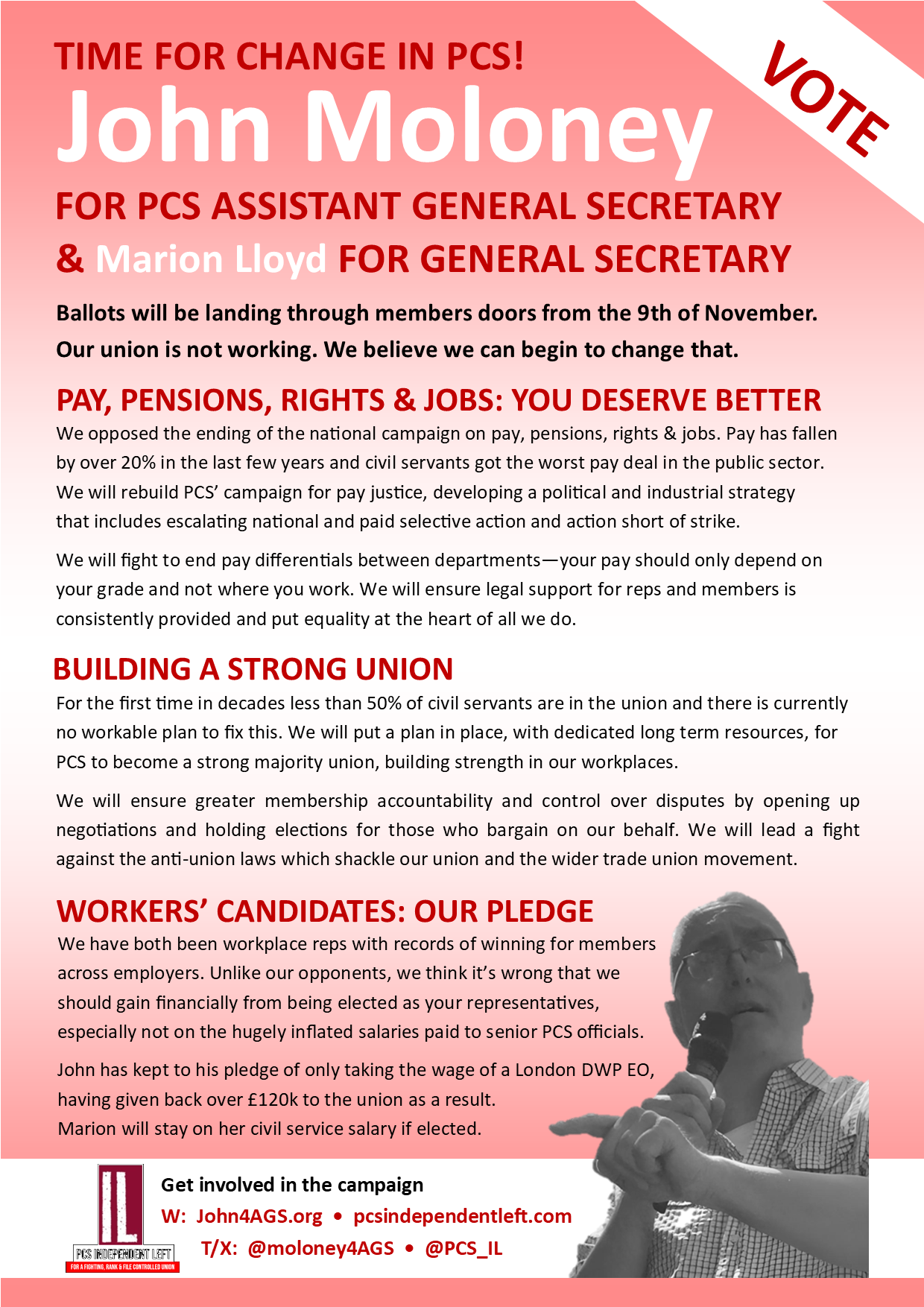
Remarkably, John Moloney of the Independent Left defeated full-time officer Paul O’Connor by 11,705 votes to 8,152 to be re-elected as Assistant General Secretary.

The closeness of the GS result and the defeat of Paul O’Connor are remarkable for several reasons. They occur in the context of Fran and Paul being the anointed successors of Mark Serwotka, the union machine being used to profile both candidates throughout the campaign and the patronising and sometimes unedifying and desperate spectacle of celebrity endorsements.

Despite the ongoing leadership claim that PCS is a member led union, the turnout in the election was appallingly low at 11.5%. Much lower than the 19% 5 years ago, and a statistic which puts the bed the justification for bringing the elections forward made by Mark Serwotka that it would increase turnout.

In this respect the election was a failure for all candidates and damning indictment on the state of the democratic deficit in the union. If barely 1 in 10 members feels any purpose in returning a ballot for the leadership of the union, something much more fundamental than simply standing in elections with decent politics is required to rebuild the rank-and-file in PCS.

Clearly, the election of the unions first woman General Secretary is a good thing. It was, of course, a foregone conclusion before the ballots were even issued as both candidates were women.

Unfortunately, there is little evidence that the result of the GS election is going to better the material conditions of women members or members more widely for that matter.

What we heard during the campaign, echoed in the closeness of the results and overwhelming return of John Moloney as AGS, is that many members are acutely aware of the dire state the union is in and the inability and unwillingness of the leadership to change or fight for better. 

In the countless members hustings events Marion and John spoke to throughout the country, most of which were boycotted by Fran and Paul who preferred to seek support from the likes of Steve Coogan, members wanted change or through debate were convinced by the alternative as laid out by Marion and John.

Members are acutely aware that this leadership strategy this year has led to the worst pay-rise in the public sector alongside a pro-rated £1500 payment which the unions own negotiators didn’t equality check, and which therefore was disproportionately lower for part-time workers and negatively impacted UC payments. Members are also aware of the Orwellian ballot to ‘continue the campaign’ on 23/24 pay, which despite members voting ‘Yes’ has now, as predicted by us, been well and truly buried.

Throughout, Fran and Paul’s campaign vaunted the increase in pay in certain departments, not mentioning that in many cases the pay-rises had nothing to do with the union and everything to do with the rise in the minimum wage and forgetting that most members listening were profoundly conscious – particularly at this time of year – that they only got a 4.5% rise.

During the campaign, members were told of ongoing talks with the Cabinet Office on 23/24 pay, but true to type these haven’t produced a result. Largely, as predicted, because the leadership strategy has given up any leverage we had by shutting the dispute. Additionally, members haven’t had an update on talks because of the unions longstanding insistence to keep much from members for as long as reasonably possible.

On both issues, the alternative presented by Marion and John, of re-energizing the national campaign, with a more creative and combative industrial strategy and of ending secretive negotiations and opening them up to membership control won many members over.

We hope that considering John’s large mandate, he will be given the remit to carry out his platform, including that of bargaining. It’s the democratic thing to do. But we also know that to really change the union we have to win the leadership.

The combined votes for the candidates for change, Marion and John, exceeded those for Fran and Paul by nearly 2770 votes or 7%. We’re not stating this to claim Fran shouldn’t have won, but to illustrate that despite everything, our ideas got through to members.

This coalition, which throughout the campaign saw many new individuals and groups of activists join, needs to maintain the same level of unity going into the NEC elections next year.

If you agree, please consider joining us at the PCS Independent Left.
For honest debate and principled solidarity

Martin Cavanagh (MC), a leading member of Left Unity (LU), recently made a number of posts concerning the Assistant General Secretary (AGS) and General Secretary (GS) elections.

Below we reply to his comments concerning debate and Palestine. In further posting(s) we will respond to his remaining points.

1. MC challenged us to “Engage in an honest debate”

John and Marion sought debate – LU candidates did not reply

We agree that debate should have been a key feature of these elections. Open hustings would have helped members to decide who they wanted to vote for in their branch nomination meetings and, afterwards, in the elections. They would also have enabled candidates to challenge any points made by rivals that they thought were incorrect, untrue, unfair.

At the outset of the election process, John Moloney, whose re-election to AGS we are supporting, and Marion Lloyd, standing for GS on a joint ticket with John, wrote to the LU candidates seeking their agreement to hustings, in which the candidates would debate each other in front of members, who would be free to ask questions and make comment.

LU candidates have avoided debate

Unfortunately, from the outset, Fran Heathcote and Paul O’Connor, the LU candidates for GS and AGS respectively, sought to avoid debate. They risibly claimed that it would be premature of them to attend hustings, because candidates needed to obtain fifteen branch nominations to get on the ballot paper and they would not know who the candidates would be until PCS formally published the branch nominations received by each individual.

The LU candidates knew full well that they, and John and Marion, would easily exceed fifteen nominations each. The LU candidates were just avoiding debate in front of members because, on the record and the arguments, their case is poor (Paul O’Connor did debate John Moloney at HMRC Long Benton but lost heavily). Instead, the LU candidates have sought to rely on the PCS machine, which they and their allies control, to boost their candidates.

In any event, Fran Heathcote and Paul O’Connor were candidates for branch nominations, competing with John Moloney and Marion Lloyd. But even after they were formally notified by PCS that they would be on the ballot paper, the LU candidates still avoided debating John and Marion in front of members. It is hard to have honest debate if the LU candidates will not enter the debating chamber.

These same LU candidates who cannot debate two other PCS representatives nevertheless want members to elect them to negotiate with Ministers and Cabinet Office officials. We respectfully advise members to doubt their capacity and to vote for John and Marion.

Debate and hustings obstructed

The London and South East Region attempted to set up regional wide hustings for the enormous number of members in that region. A single cross branch hustings meeting would have enabled members to hear the candidates directly irrespective of whether their hard pressed branch representatives had organised hustings (the vast majority had not) and boosted membership participation in the election. Any democratic Union leadership should welcome such an initiative.

Instead, the outgoing General Secretary, who is backing his LU allies and friends despite being the returning officer, refused to send out details of the proposed meeting to members. He said that the regional committee had no “locus” in the election process (by strange coincidence, Paul O’Connor has also used this phrase when replying to invitations).  The L&SE Region proceeded to build the hustings as best they could and it proceeded without the presence of the LU candidates. 

LU candidates claim celeb support but are silent on LU supporters who have given on them

Unable to claim the support of members gained in open debate, the LU candidates have instead claimed the support of…celebs! That is their idea of a mature approach to the AGS/GS elections and the key issues impacting members.

While avoiding debate and engaging in silly celeb stunts, the LU candidates choose not to talk about:

  • The recent mass resignations from LU of long standing HMRC members who could no longer tolerate the incompetent and exclusive way the LU leadership run PCS.
  • The resignations from LU of two longstanding Black NEC members, after being told “We Don’t Do Black for Blacks sake.” One of these NEC colleagues is advising members to vote for John  Moloney and Marion Lloyd.
  • A former LU NEC member, who was made redundant, imploring members to vote for Moloney and Lloyd because of her woeful experience of their leadership.

 2. MC challenged us to “Talk about why your candidates seem more interested in the Ukraine than Palestine.”

Despite his use of the plural “candidates”. MC’s challenge was obviously aimed at John Moloney.

In the wake of his call for honest debate, we are compelled to note that his comment is an untrue, unsustainable, and obnoxious attempt to misuse for factional purposes the dreadful events in Israel/Palestine –  which, here in the UK, has seen a disgraceful rise in antisemitism and Islamophobia. This moment requires solidarity and principle from British trade unions.

John Moloney’s election address statement on Israel/Palestine crisis

In his election address, which was submitted before the Israeli invasion of Gaza had begun, John devoted 38 words to Israel/Palestine, compared to 21 words to Ukraine. John did so because he wanted every member to be able to understand his in principle position on the unfolding crisis.

John stated:

“I advocate an immediate halt to the siege of Gaza; condemn Hamas’ attacks; condemn collective punishment of Gaza and settler attacks in the West Bank; and champion an independent Palestine alongside Israel – for two states and equal rights.”

The siege having since turned into invasion, John has supported the calls for an immediate ceasefire. His call for two states is consistent with PCS policy.

The LU candidates election address (non) statements on Israel/Palestine

Neither Paul O’Connor nor Fran Heathcote mentioned Palestine in their election addresses, despite the horror that was unfolding at the time. We only comment upon this now because of the need to set the record straight after MC’s attack on John Moloney.

MC should “Talk about why his candidates seem disinterested in Palestine”

If MC is honest, consistent, and genuinely interested in Palestine, and was not just misusing the horror of what is happening to launch a dire but dim factional attack upon John, he would now publicly demand to know why the LU candidates did not show interest in Palestine in their election addresses or apologise to John. We invite him to do one or the other.

John and Ukraine

PCS has clear policies, established at the 2022 and 2023 Annual Delegate Conferences (ADC),  supporting the Ukrainian people’s right to defend themselves and Ukrainian trade unions.

Motion A55, moved by the NEC at 2023 ADC and overwhelmingly passed, instructed the NEC to send a solidarity delegation to Ukraine in cooperation with Ukrainian unions and the Ukrainian Solidarity Campaign. The NEC subsequently agreed to send John, in his official capacity as AGS, and NEC member Bev Laidlaw, to meet with Ukraine trade unions and deliver some resources. John and Bev Laidlaw duly carried out that task.

At no time has a single LU NEC member claimed that the NEC’s compliance with Motion A55 deprioritised PCS’ solidarity and work around Israel/Palestine. How could they, after submitting A55 to conference? Such a claim would be ridiculous and outrageous, except, perhaps, in the overly factionalised view of MC.

PCS must fight for flexible working for all

The announcement by the Cabinet Office this week that departments must immediately seek to ensure workers increase their presence in offices from 40% to 60% should not come as a surprise.

The Tories are feeling confident in their ill treatment of civil servants. Having successfully imposed the worst public sector pay settlement on us, the government is feeling confident. They are also in a dire political situation and are looking for ways to help the Tory Press divert attention away from the Government’s failings. Picking on civil servants yet again is one of their go-to techniques.

We have been asked what our response is and how the union should respond to it.

The current policy is unequal, unnecessary and unworkable.

The first thing to say is that the default position of the union should be that workers should have ultimate flexibility to choose to work from home or the office, including operational staff where this can be enabled by technology. A policy of mandating any arbitrary percentage is unnecessary, unworkable and inequal.

The union should have already demanded an equality impact assessment: The requirement to attend the office clearly heavily and negatively impacts those with disabilities, caring responsibilities, and young parents.

Since the government has sold off swathes of floorspace over the past 2 years, in many workplaces there simply isn’t the capacity to support 60% office attendance. If implemented this policy will create a two-tier workforce of those who can be mandated and those who can’t.

Ultimately, this policy will increase the amount of time and money spent on travel. With the cost of living still incredibly high and most civil servants receiving the lowest pay rise in the public sector, this represents yet another hit on our salaries and standard of living and is likely to impact morale and productivity.

How should the union oppose this?

To be clear, the union leadership should have challenged the end of flexible working far more robustly. However, we are where we are. This is what we would do:

  • Insist on the principle of flexible working and employee choice.
  • The legal duty of the Cabinet Office is to consider all the equality evidence of each proposal. The union must write to them demanding this evidence when the policy was first mooted. Also requesting any plans for a post-implementation impact assessment.
  • It is likely that the Cabinet Office will claim to respect their legal duty. But without a public impact analysis and commitment on the back of this proposal, none of this can be guaranteed.
  • As any equality impacts from the Cabinet Office will be conducted based on generalities, the union must also demand that individual Departments impact asses on the basis that in the large operational departments such as DWP and HMRC, there will be impact differentials between operational staff and Corporate Centre/HQ staff.
  • To prove the legal case on equality grounds the union needs to ask for a breakdown of each part-time worker in each department, broken down by gender and then by child carers, those who work part-time for health reasons etc.
  • The employers’ assessments are likely to be substandard, so the union should carry out its own equality impact assessment based on the above.
  • The legal department should be immediately instructed to challenge the policy on this basis with the stats publicised to members. There is a likely potential for taking test cases on behalf of all civil servants and these should be immediately identified and secured.
  • The stats to compare workplaces that can accommodate 60% to those that can’t should be requested, by FOI if not forthcoming. In the DWP for example there will be offices which can and those which can’t, and this has been acknowledged by the Cabinet Office and several individual departments. Our bargaining position both nationally and in bargaining units must be that the policy cannot negatively impact workers based on where their office is.
  • In the immediate term, advice and guidance should be supplied to department negotiating teams on the unions position bargaining position alongside a risk-based assessment on the impact of non-compliance. Reps and members should be reassured that they will receive legal support and the legal department should be mandated to that effect.
  • Guidance and templates should be produced for members being asked to increase their time in office who have caring responsibility or health issues to challenge any management action to increase their time in the office, with training provided to reps on how to fight this in each department.
  • The union should use all communication avenues not just to publicise opposition to the latest attack, which is what’s being produced at present, but to make the political case for flexible working. Highlighting the positive impacts on both the individual and public services as well as the hypocrisy of the politicians demanding an arbitrary return.
  • We should work to enshrine the rights to flexible working within contracts and staff handbooks. In the DfT, John Moloney made sure that rights to things such as check-off and attendance rights were so when the coalition government came for them, they legally couldn’t change them. In the past the current leadership have accused us of ‘legalism’ for suggesting others should do the same, but it was our members who were protected while others, such as those in the DWP, had their rights torn from them without challenge. We should use all options available to us.

Further considerations…

Enabling members to work from the office if they wish to

We know from departmental teams, membership feedback, and casework, that some members prefer or need to be in the office for well-being reasons. We defend the right of those members to do so with good quality accommodation, appropriate H&S measures in place, and where appropriate, reasonable adjustments. 

But even then, we must insist on the right of those members to decide how long they will be in the office, making time up at home on the same day or later if need be.

Enabling members to work from home according to their judgment

Civil servants should be able to make their own judgements about their circumstances and work needs (which may change over time) and where they work from.

Mandating any arbitrary percentage is unnecessary, unworkable and unequal. It will adversely impact colleagues with particular “protected characteristics” (most obviously those with dependent care responsibilities, very disproportionately women, and health issues). The underlying logic of the Tories and the mandarins is that greater expectation of office-based working will be underpinned by the misconduct procedures if someone “unreasonably” fails to comply with the expectation. 

Consistent with technical, socio-economic direction of travel

This approach would not prevent management from genuinely encouraging – as opposed to pressurising – people to attend the office, but it would be consistent with the technological, organisational, and economic direction of travel and the experience of recent years.

It is obvious that some parts of the civil and public sector and private sector see greater trust in employees’ judgements and preferences, and greater work location flexibility, as a way of recruiting, retaining and motivating their workforce. A civil service wide policy, under the divide and rule pretence of delegation – would deprive management teams of those tools.

Equality impact evidence and assessments and building in protections

PCS must demand to see what equality evidence the Cabinet Office took into account in drawing up its policy and what equality impact assessment it produced: The requirement to attend the office clearly heavily and negatively impacts those with disabilities and health issues, partner and extended family caring responsibilities, and parents.

It should insist on receipt of the same data and assessments from each individual civil service “bargaining unit” that is considering enforcing greater office working. And, without prejudice to our in-principle position, it must seek to strengthen the rights of members and the equality protections.

Flexibility – a vital requirement for carers

A long-term policy of employee choice flexibility will enable carers to work full time or to contract more hours on a part time or other flexible working pattern because commuting time may be converted to contracted working. That is a boon to pay, pensions and long-term security, especially for women and colleagues with health issues. Insisting on the commute is tantamount to insisting on some members working reduced hours.

For certain, without prejudice to our in-principle position of the location of work being a matter of judgement for all members, those who work part time hours need to be able to decide whether, when, and for how long they attend the office on the basis of what makes sense given their circumstances and working pattern. Not commuting lessens the stress of trying to leave work on time to get home for a dependant.

Percentages of contracted hours potentially discriminates

Equally, as the demand is represented as a percentage rather than attendance days, part-time workers will be greatest hit. Any expression of office time in “percentage” terms may mean that the part time worker must end up with an unsustainably long working day, with impacts on health and the ability to maintain dependent care – or a more “normal” working day plus one or more short days that are not justified as a good use of time against the commuting time.

Government selling off or surrendering estate

Since the government has sold off swathes of floorspace for many years, including the past two years, in many workplaces there simply isn’t the capacity to support 60% office attendance. The Cabinet Office freely admits this. But the lack of desks:

  • Raises health and safety issues in overcrowding, blocking of passage ways and escape routes, and people working in “break out areas” and staff canteens.
  • Creates problems for members who require special facilities as reasonable adjustments.
  • Will create a two-tier workforce of those who will be mandated and those who will not and, because mandating will be left to individual managers, the result will be arbitrary, potentially discriminatory, and result in unfair, inconsistent, application of conduct procedures for “failure to attend.”
  • In and of itself, before we think about issues such as dispersed teams, the lack of desking and meeting rooms in some areas undermines the claimed benefits of increased office attendance because you do not get to sit with colleagues, who may not even be in on the same day, and you still join meetings by teams.

Further reducing living standards

Enforced greater office attendance will increase the amount of time and money spent on travel. With the cost of living still high, with the value of civil service pay in long term decline, with the last few years of brutal reductions in our purchasing power, not commuting or commuting three or more days a week is one way in which members have sought to get by. This is a further attack on our already reduced living standards.

Vote for Marion & John

The current leadership is unlikely to challenge this policy competently. Just as they haven’t in the past when it was important to challenge the end of flexible working. If you want leaders who have the ideas, the will and the track record to ensure these things are challenged correctly, please vote for Marion Lloyd and John Moloney in the current General and Assistant General Secretary elections.

PCS election candidates: A career move or a Trade Union commitment?

What sort of trade union do we want PCS to be?

The PCS Independent Left is clear: a trade union championing membership interests, run by members, employing elected officials who are in touch with members and who are not elevated to a lifestyle out of kilter with the mass of those members by dint of their trade union employment.

“Another world” salaries paid to senior PCS officials

The current General Secretary, Mark Serwotka, takes £103,100pa for the privilege of being General Secretary. Fran Heathcote, Left Unity’s candidate to replace Serwotka, is fully in favour of such grotesque salary levels being paid for out of membership subscriptions. So is Paul O’Connor, LU’s candidate for Assistant General Secretary.

The PCS Independent Left is not. We think PCS salaries at this level are wholly wrong. Such incomes are in another world compared to the lives of tens of thousands of PCS members.

Mark Serwotka once agreed

When he was a young radical Mark Serwotka agreed with these views. In fact they were once common place amongst socialists of various hues in PCS.

The Mark Serwotka pay test

When Mark Serwotka first stood for election for GS in 2000, he contrasted his position as a part time EO (he had child care responsibilities) to the status and earnings of his opponent, a senior PCS official. He saw those difference as important in determining who should be elected. Paul O’Connor supported Mark in that election.

Applying that same Serwotka test today, Paul O’Connor is a very long time, very well paid, PCS official who will become wonderfully well paid if elected to AGS. John Moloney, on the other hand, dedicated his life as an AO and, very belatedly, an EO lay representative. Since he was elected as AGS in 20219 John has donated £120,000 back to PCS. Like Mark Serwotka in 2000, we think these differences and facts count for a great deal in this election.

PCS needs a rational wages policy

PCS needs a rational wages policy reflecting the sort of PCS we need. Individuals’ donating money to the PCS Fighting Fund, as a matter of conscience and socialist principle, is to be welcomed, but a rational wages policy would be better.

Reliance on conscience has not been successful. If you look at the annual accounts going back some years, you will see that virtually nothing has been donated back by the most senior officials apart from the outstanding exception of John Moloney, the current Assistant General Secretary and a candidate in the current AGS election – over £120,000 since his election in 2019.

The IL’s expectation of our candidates for high office

Given the reality of PCS – massively inflated salaries endorsed by Left Unity – we discuss with our candidates for senior office what they might reasonably retain and what they should donate back to the union – the Fighting Fund – to support PCS members who paid that money in subscriptions.

This policy is not an optional extra for us. We want employment by PCS to be one aspect of people’s very serious commitment to our trade union, not the smartest, most prosperous, career move they could make.

John Moloney’s  pay commitment will tie his AGS income to DWP EO

John Moloney has renewed his commitment, first made ahead of being elected AGS in 2019, to tie his income to that of the London EO DWP maxima. As previously advised, John has to date returned over £120,000 to the PCS Fighting Fund, money which has helped fund strikes by PCS members. John has also thereby tied his future income to pay movements in DWP. Our pay interests are his.

Marion Lloyd’s pay commitment will tie her GS income to £30,000 pa and BEIS pay movements

Marion earns £30K pa, pro-rata. Marion has committed to staying on the same income, while moving to full time hours as GS, and returning the balance to the PCS Fighting Fund. Marion has also tied her future income to pay settlements in her current department. 

Paul O’Connor’s commitment: I will take AGS guaranteed pay progression to £103,100pa.

Currently O’Connor  is what is called a Band 6 in PCS. That band has a maximum of £73,122, which we assume he is on because PCS officers enjoy pay progression. If elected O’Connor would join the AGS pay scale with guaranteed progression up to the current maximum of £103,100. he is very clear that he will take every penny of that inflated salary.

In a rare hustings – he and Fran have been desperately avoiding debate in front of members – Paul O’Connor stated that when he wakes up he is focussed on keeping wages up, not on moving them down.

It is a woefully insensitive way of justifying a huge income because O’Connor and his allies have been very unsuccessful in keeping members pay up. We have had years of pay freezes and below inflation awards and tens of thousands of members are on or hovering above minimum wage. But he is asking you to elect him on that record and to a salary he would never have received as a civil servant and which you, the members, can only dream of.

The logic of Paul O’Connor’s position – one that Left Unity shares – is that if the union paid £200,000pa to its AGS and GS he would fight to keep that salary up, as well as keeping it! The hearts of the LU socialists supporting the Heathcote/O’Connor ticket to pay heaven must bleed for bankers when they read about attacks on bankers’ incomes…let’s keep pay up shout the LU socialists!

Fran Heathcote’s commitment: I deserve £103,000pa.

At one (rare) hustings, Fran Heathcote  was asked whether she would take the GS money. She did not say “no.” and she did not say “yes”, to a very simple question and in  contrast to Marion Lloyd’s, and John Moloney’s pledges  and Paul O’Connor’s clear commitment to keeping all the money as the due of a PCS AGS.

Until she clarifies her position, and given LU’s consistent support for these salary levels, it is fair to assume that Fran will, if elected,  take the full GS salary and progress to £103,000pa. She is certainly happy that her running mate will take every penny.

Any grade of member that PCS represents earn a lot less – for most a great deal less – than an AGS and GS. If we take a hypothetical  DWP EO in the national pay area, Fran’s grade, would earning £29,500pa but, upon being elected to GS, that EO member would move  to £74,820pa, a pay rise of £45,320 i.e. 253%. That would be an inflation busting pay increase!

Of course, the same calculation could have been made for John Moloney in 2019, except that he committed to not accepting such a huge leap in pay and progression to that mouth watering maximum.

The Wage Argument begins to hurt LU – so they spin nonsense

LU – now little more than the Fran and Paul fan club and shedding members everywhere (see here and here) say,

“Repeatedly members will hear claims that their [IL’s and Broad Left Network’s] candidates are pledging to take a worker’s wage if elected, because they understand how low paid members’ struggle. They omit to clarify, however, that their GS candidate is a G6 manager with a pro-rate salary higher than that of Fran’s wage as an EO in DWP, or that since elected in 2019, their AGS candidate has taken the rate for that job before personally deciding how much he can afford to donate to causes he supports.”

The statement is dishonest but revealing:

  • John Moloney was very explicit, before first being elected to AGS in 2019, that he would tie his salary to the DWP EO maximum (his then LU opponent was committed to taking the full whack).
  • Upon election he asked not to be placed on the enormous AGS gsalary but to be paid the DWP London EO wage, saving PCS salary but also the NI and taxation on the higher wage. The leadership said no but that he could donate the money back. That is what he does – every penny to the PCS Fighting Fund.
  •  Marion is a G7, not a 6. In the IL we are very happy to have supporters in all the grades represented by PCS and we fight for all members irrespective of grade. But if  the LU leadership of a multi-grade union want to dismiss   G7 and 6 members, that is their privilege. W. The real point, and typically  this is not addressed by LU,  Marion will stay on £30000 pa if elected whereas Fran Heathcote and Paul O’Connor will take every penny.
  • LU do not deny that they are really happy for their candidates to be paid £103,000 pa from membership subscriptions.
  • We do not say that we will take a worker’s wage because we “understand how low paid members’ struggle” (although it is obnoxious to spend the subscriptions of members on minimum wage on such salaries). We argue that officials should not receive salaries that result in their being totally out of touch with, and with no stake in the bargaining and campaign outcomes for, members. 
  • £103,100 pay is a fortune compared to the salaries of HEO’s and SEOs for example. It is a lot more than G7 and G6 members. It is a lot more than most senior civil servants earn!

Vote for the kind of PCS you need, Vote Marion and John.

Fact Checking the PCS leadership: ‘Breakthrough on Pay’?

The General Secretary has claimed in a Tribune article that:

But one of the things that we won was national talks about changing civil service pay structures to deal with low pay and inherent issues.

This is factually untrue.

If you go here you will see that what Cabinet Office Minister really said about what the government’s intends:

Finally, in looking at the right approach to future reward strategy in the Civil Service, the Government intends to draw on the views of trade unions, including with respect to lower paid staff and how best to encourage greater coherence within the delegated Civil Service structures.

No matter how you stretch and torture the English language you cannot make the above be the same as ‘we won was national talks about changing civil service pay structures to deal with low pay and inherent issues’.

All the Tories have committed to do, is to listen to the trade unions (draw on our views) about lower paid staff and to our views as to how to best encourage greater coherence. Mark Serwotka has, of course, set those views out many a time – at least we hope he has – but to no effect.

But the leadership has form when it comes to ending pay campaigns while claiming breakthrough talks (but interestingly never a breakthrough on our actual salaries!). He made the same claims of a breakthrough on national pay in 2005 and 2008. In a PCS website posting on 2 December 2008, the leadership announced:

“PCS today announced a breakthrough its pay campaign by reaching a national agreement [it had not!] with the government over pay…money from ‘efficiency savings’ will now be released for pay bargaining…” (it was not)

The PCS online report continued:

 “Mark Serwotka, PCS general secretary, said ‘This agreement [he never had one] is an important breakthrough [it was a break down of our action]…over the coming weeks and months we will be ensuring [he did not] that this agreement produces better pay for the low paid civil and public servants [it did not!]…” 

And now of course he and his allies are pushing similar lines in 2023. This is a lucky leadership – not many get to achieve three national breakthroughs in 18 years.

The members have not been so lucky, because none of these breakthroughs have added one penny to their ever declining salaries on his watch.

His, and Fran Heathcote’s and Paul O’Connor’s, “get the best deal possible” out of the 2023 pay round, predictably resulted in the great bulk of us once again receiving below inflation awards and the worse pay settlement in the public sector.

They could all have learned lessons from 2005 and 2008. But instead, those of us who have been around long enough, are witnessing a rerun of the leaderships’ long rehearsed tactic of avoiding or withdrawing from a campaign for real money on the table with a promise of talks that are misrepresented to make the winning of more money seem a good prospect.

So why does Fran, Mark and Paul make claims that have no substance?

Partly, because they have no confidence in the union’s ability to win a fight – a lack of confidence. A fear that the Tories can see and smell. So, they wanted out of the 2022 pay fight and to avoid a 2023 pay fight, hence the refusal to submit a national claim, in order to claim “significant concessions” through all the resources of PCS in the runup to the AGS and GS elections.

If Fran Heathcote and Paul O’Connor win, it won’t matter if there are no national talks or talks do not result in significant improvements to, civil service pay structures, coherence issues, and  the incomes of our many low paid members, They will already be in office and with high staff and membership turnover as well as control of PCS Communications, the claims will be forgotten.

The PCS leadership is the union equivalent of Orwell’s ‘Oceania’, in his dystopian novel “1984”, in its exploitation of the concept of ‘unremembering’. The claim of such talks, and their hyping by the leadership, will have served its purpose of persuading some activists and members that we did make a breakthrough and to vote for the LU candidates.

In a membership led trade union the leadership would  publish the timetable and the terms of reference of national pay and jobs talks.

We challenge the General Secretary to do so now, or admit that just as in 2005 and 2008, all you have delivered is spin and hype – and that don’t pay the bills.